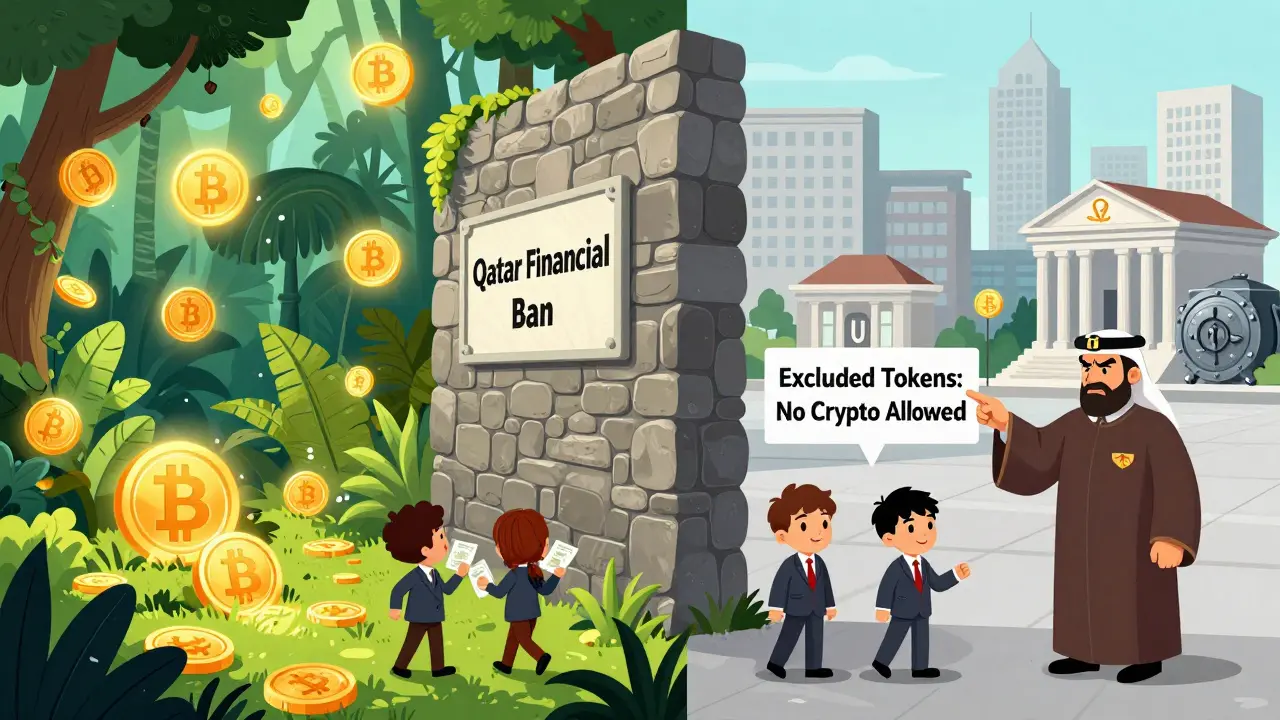
Qatar doesn’t just discourage cryptocurrency - it blocks it from its entire financial system. While countries like the UAE and Bahrain welcome crypto firms with open arms, Qatar has built a wall around its banks, investment firms, and financial institutions. Since 2018, no licensed financial entity in Qatar can touch Bitcoin, Ethereum, or any other cryptocurrency. Not as a payment tool. Not as an investment. Not even as a custody service. This isn’t a temporary rule. It’s a permanent, tightly enforced policy - and it’s reshaping how finance works in the Gulf.
How the Ban Works: A Clear Line in the Sand
The Qatar Central Bank (QCB) issued Circular No. (6) in February 2018. It was short, blunt, and left no room for interpretation: financial institutions were forbidden from facilitating any Bitcoin or cryptocurrency transactions. That meant banks couldn’t process crypto deposits, brokers couldn’t offer trading accounts, and asset managers couldn’t include digital assets in portfolios. The message was clear: crypto doesn’t belong in Qatar’s regulated financial ecosystem. Two years later, the Qatar Financial Centre Regulatory Authority (QFCRA) doubled down. On December 26, 2019, it issued a formal alert banning all virtual asset services within the Qatar Financial Centre - the country’s main hub for international financial firms. The definition was precise: virtual assets meant digital substitutes for currency used for trading, transferring, or paying for goods and services. That covered Bitcoin, Ethereum, stablecoins like USDT, and even central bank digital currencies (CBDCs). All of them were classified as "Excluded Tokens." The ban wasn’t just about trading. It blocked every possible interaction:- Exchanging crypto for Qatari riyals or US dollars
- Storing or safeguarding crypto assets on behalf of clients
- Offering financial services tied to crypto issuances or token sales
- Using crypto as a payment method in any institutional transaction
Why Qatar Took This Path
Qatar’s stance isn’t random. It’s rooted in three core priorities: financial stability, monetary control, and risk avoidance. First, the country views cryptocurrency as a threat to its sovereign monetary system. Unlike decentralized networks that operate outside central bank oversight, Qatar’s economy runs on a tightly managed currency. Allowing crypto into the financial sector would create parallel payment systems - something regulators see as dangerous. Second, crypto’s volatility is a major concern. Bitcoin’s price swings of 30% or more in a single week are normal. For institutions managing pensions, insurance funds, or sovereign wealth, that kind of unpredictability is unacceptable. Qatar’s Third Financial Sector Strategic Plan and Qatar National Vision 2030 prioritize long-term, low-risk growth. Crypto doesn’t fit that mold. Third, Qatar has watched how other GCC countries handled crypto. The UAE, for example, allowed crypto exchanges to operate with licenses. Bahrain created a full regulatory sandbox. But Qatar chose isolation. Its regulators concluded that the risks - money laundering, fraud, systemic instability - outweighed any potential innovation. This makes Qatar one of the strictest countries in the GCC. Kuwait shares a similar ban. Saudi Arabia allows limited CBDC experiments but blocks retail crypto. Meanwhile, the UAE and Bahrain are actively attracting crypto firms with tax incentives and clear licensing.The Twist: Tokenized Assets Are Welcome
Here’s where things get interesting. While crypto is banned, tokenized assets are being actively encouraged. On September 1, 2024, the QFCRA launched the QFC Digital Assets Regulations. This isn’t a loophole. It’s a deliberate carve-out. The new rules allow financial institutions to issue, trade, and custody digital tokens - but only if those tokens represent real-world assets like:- Shares in Qatari companies
- Sukuk (Islamic bonds)
- Real estate holdings
- Commodities like oil or gas

What This Means for Businesses
For international banks operating in Qatar - like HSBC, Citibank, or Standard Chartered - the ban forces a split operation. Their Dubai office can offer crypto trading. Their Doha office cannot. They need separate compliance teams, separate IT systems, and separate legal structures just to stay in line with Qatari rules. Fintech startups trying to enter the market face an even steeper climb. Any product that touches crypto - even a wallet app that lets users track Bitcoin prices - is blocked. No licenses are available. No exceptions. The only path forward is building products around tokenized securities, which requires deep ties to real estate, sovereign wealth funds, or Islamic finance institutions. For investors, the impact is direct: you can’t buy crypto through your Qatari bank. You can’t invest in crypto ETFs. You can’t even hold it in a custody account offered by a licensed firm. If you want exposure, you have to buy it overseas - and bring it in as personal assets, not institutional ones.How Enforcement Works
Qatar doesn’t rely on public warnings. Its enforcement is quiet, consistent, and severe. All financial institutions must submit annual compliance reports proving they have no crypto-related activities. Auditors from the QCB check transaction logs, customer onboarding records, and internal policies. Any sign of crypto processing - even a single transaction - triggers an investigation. Penalties include:- Immediate suspension of license
- Fines up to 5 million Qatari riyals (about $1.37 million USD)
- Personal liability for senior compliance officers
- Blacklisting from future licensing

What’s Next? The Future of Crypto in Qatar
Experts agree: the institutional ban on cryptocurrency won’t be lifted. Not in 2025. Not in 2030. Qatar’s leadership sees crypto as incompatible with its financial model. The country’s wealth comes from oil, gas, and state-backed investment - not speculative markets. But the digital assets framework will expand. By mid-2025, the QFCRA is expected to add new asset classes to the approved list - possibly private equity stakes, infrastructure bonds, or even carbon credits. This could make Qatar a regional hub for blockchain-based asset management - but only for assets with real, tangible value. Meanwhile, Qatar is quietly developing its own central bank digital currency (CBDC), likely tied to the riyal. Unlike Bitcoin, this won’t be decentralized. It will be fully controlled by the QCB. It won’t be for public use. It will be for interbank settlements - a move that reinforces, not weakens, the ban on crypto.How Qatar Compares to the Rest of the GCC
| Country | Crypto Policy | Key Regulatory Body | Institutional Access | Tokenized Assets Allowed | |--------|----------------|---------------------|----------------------|--------------------------| | Qatar | Full ban | QCB, QFCRA | No | Yes (strictly controlled) | | UAE | Fully licensed | DFSA, ADGM | Yes | Yes (broadly allowed) | | Bahrain | Open sandbox | CBB | Yes | Yes (with licensing) | | Saudi Arabia | Retail ban, CBDC focus | SAMA | Limited (wholesale only) | Yes (in pilot phase) | | Kuwait | Full ban | CMA, CBB | No | No | Qatar and Kuwait are the only two GCC countries with total institutional bans. The UAE and Bahrain are racing to become crypto hubs. Saudi Arabia is building a digital currency for banks - not for people. Qatar? It’s building a digital ledger - but only for assets that already exist in the real world.Final Take
Qatar isn’t anti-technology. It’s anti-risk. It doesn’t want to be the next crypto playground. It wants to be the most stable financial center in the region. That means keeping Bitcoin out - but letting blockchain in, under strict rules. For investors and institutions, the message is simple: if you’re looking for crypto exposure in the Gulf, look elsewhere. If you’re looking for secure, regulated digital asset innovation - Qatar is one of the most promising places on earth. Just don’t expect to trade Bitcoin there.Is cryptocurrency completely illegal in Qatar?
No, cryptocurrency isn’t illegal for individuals to hold or buy privately. But it’s strictly banned for all licensed financial institutions - banks, investment firms, insurance companies, and fintechs operating under QCB or QFCRA oversight. You can’t use crypto to pay for services, trade through a Qatari broker, or store it in a bank-managed wallet.
Can I buy Bitcoin in Qatar using a local bank?
No. All licensed banks in Qatar are prohibited from facilitating cryptocurrency purchases, sales, or custody. Even if you have an account with a Qatari bank, you cannot use it to buy, sell, or transfer Bitcoin or any other cryptocurrency. Any attempt to do so through a regulated institution will be blocked and reported.
What’s the difference between crypto and tokenized assets in Qatar?
Crypto (like Bitcoin) is a digital currency meant to replace money. Tokenized assets are digital representations of real-world assets - like shares in a company, real estate, or bonds. Qatar bans the first, but actively permits the second. Tokenized assets must be backed by tangible value and regulated under the QFC Digital Assets Regulations.
Can foreign crypto companies operate in Qatar?
No. Foreign crypto exchanges, wallet providers, or trading platforms cannot obtain a license to operate in Qatar. Even if they’re licensed in the UAE or Singapore, they are barred from offering services to Qatari residents or institutions. Any attempt to do so violates the QFCRA’s 2019 alert and risks legal consequences.
Will Qatar ever allow Bitcoin trading in the future?
Experts believe it’s extremely unlikely. Qatar’s regulatory philosophy is built on control, stability, and sovereign monetary authority. Bitcoin’s decentralized nature directly contradicts those values. While tokenized assets will grow, native cryptocurrencies like Bitcoin will remain excluded from the institutional financial system indefinitely.

Rebecca Andrews
I'm a blockchain analyst and cryptocurrency content strategist. I publish practical guides on coin fundamentals, exchange mechanics, and curated airdrop opportunities. I also advise startups on tokenomics and risk controls. My goal is to translate complex protocols into clear, actionable insights.
20 Comments
-
lori sims
March 2, 2026 AT 05:31Qatar’s playing 4D chess while the rest of the GCC is playing checkers. 🎲 They’re not anti-tech-they’re anti-chaos. Tokenized assets? That’s the future: blockchain without the dumpster fire of speculative mania. Real assets. Real value. Real stability. I’m weirdly impressed.
-
Reggie Fifty
March 3, 2026 AT 14:28Typical socialist nanny state. Crypto is freedom. Bitcoin is the people’s money. Qatar’s just scared their petro-monarchy can’t compete. They’re clinging to fiat like it’s a security blanket. Pathetic.
-
Kristi Emens
March 5, 2026 AT 13:51It’s fascinating how different regulatory philosophies emerge based on cultural priorities. Qatar’s focus on systemic stability over innovation makes sense when you consider their economic foundation. It’s not about suppressing tech-it’s about protecting what they’ve built.
-
Deborah Robinson
March 7, 2026 AT 03:47I love how they’re not banning blockchain-just the wild west version of it. Tokenized real estate and sukuk? That’s actually genius. You can have innovation without letting chaos in. 💡 It’s like letting a toddler play with LEGOs but not with fire.
-
Michelle Mitchell
March 9, 2026 AT 02:19so like… if i buy btc on binance and keep it in my wallet… is that illegal? idk man. the whole thing feels like a paradox. why ban it but allow digital versions of it? 🤔
-
Kaitlyn Clark
March 9, 2026 AT 10:27Y’all are overcomplicating this. Qatar’s not ‘anti-crypto’-they’re anti-idiots who think Bitcoin is money. Tokenized assets? YES. That’s finance. Crypto? NO. That’s gambling with a blockchain sticker on it. 💥 Let’s stop pretending this is about tech. It’s about control. And honestly? Good for them.
-
christopher luke
March 10, 2026 AT 10:46This is actually one of the most thoughtful approaches I’ve seen. Instead of pretending crypto is the future, they’re building a better one. Real assets on blockchain? That’s not just smart-it’s visionary. 🙌 We need more countries like this.
-
Mary Scott
March 10, 2026 AT 16:26They’re lying. They’re just scared the West will hack their system. This whole ‘tokenized assets’ thing? It’s a trap. They’re building a digital surveillance ledger. You think they can’t track every transaction? They already are. 👁️🗨️
-
Shannon Holliday
March 12, 2026 AT 15:33Qatar’s approach feels so… intentional. Like they looked at the chaos in Dubai and said, ‘Nope, we’re doing this differently.’ Tokenized sukuk? That’s cultural alignment meets innovation. Respect. 🌿
-
Amanda Markwick
March 12, 2026 AT 17:23Let’s be real: the real innovation here isn’t blockchain-it’s the *regulatory discipline*. Most countries are either blindly embracing crypto or outright banning it. Qatar’s doing the hard thing: carving out a space where innovation serves stability, not the other way around. This could be a blueprint for sovereign wealth funds globally.
-
Arya Dev
March 13, 2026 AT 08:14Ohhhhh, so now it’s ‘tokenized assets’? That’s just crypto with a Quran on it. They’re not smarter-they’re just trying to look religiously superior. And the CBDC? That’s just digital slavery. They’ll track your coffee purchases next. 😭
-
Leslie Cox
March 14, 2026 AT 15:17Let’s not romanticize this. Tokenized assets? That’s Wall Street’s way of rebranding financial engineering as ‘innovation.’ It’s the same old game-just with a blockchain UI. Qatar’s not visionary. They’re just avoiding the risk of being outshined by Dubai. And honestly? Boring.
-
Fiona Monroe
March 16, 2026 AT 02:07Qatar’s regulatory framework exhibits a remarkable degree of precision and foresight. The distinction between unbacked digital currencies and tokenized real-world assets is not merely semantic-it is ontological. By anchoring digital representations to tangible, regulated assets, the QFCRA has constructed a compliance architecture that is both legally robust and economically coherent. This is not resistance to innovation; it is its maturation.
-
Molley Spencer
March 18, 2026 AT 00:02Tokenized assets? Please. It’s just crypto 2.0 with compliance theater. They’re not preventing risk-they’re just shifting it to institutional gatekeepers who’ll charge 3% fees and call it ‘asset management.’ Meanwhile, Bitcoin’s decentralized network is already worth $1.2T. This is a power play, not a policy.
-
John Fuller
March 18, 2026 AT 06:51So crypto’s banned but digital bonds are fine. Cool. Makes sense. Nothing else to say.
-
Lucy Simmonds
March 19, 2026 AT 17:34They’re all in on the CBDC… which means the government can freeze your money anytime. They say ‘tokenized assets’ but they mean ‘control everything.’ You think they’re protecting stability? They’re building a digital police state. And you’re all just clapping? 🤡
-
Maggie House
March 20, 2026 AT 15:33Wait so if I own a piece of Qatari real estate and it’s tokenized… can I sell it to someone in Germany? Is that allowed? I’m just trying to understand the real-world impact 😊
-
Sean Logue
March 21, 2026 AT 04:06Qatar’s the only Gulf country that gets it. You don’t need Bitcoin to build the future. You need smart infrastructure. Tokenized sukuk? That’s the future. Crypto? That’s a meme. And I’m here for it.
-
Carl Gaard
March 21, 2026 AT 20:52Qatar’s not banning crypto… they’re banning the idea that money should be wild. 💪 Tokenized assets? That’s finance with discipline. Bitcoin’s like a teenager with a credit card. Tokenized real estate? That’s a CEO with a strategy. And honestly? I’d trust the CEO any day.


Write a comment
More Articles

ACE Crypto Exchange Review: Is Taiwan's First Licensed Platform Right for You?
Discover if ACE Exchange fits your needs. As Taiwan's first licensed crypto platform, it offers secure TWD trading but limited assets. Read our full review.

Cheryl Fenner Brown
February 28, 2026 AT 18:53So Qatar’s like the strict mom who says ‘no candy’ but lets you eat broccoli with a side of glitter? 😅 I mean… tokenized assets? That’s just crypto with a fancy suit and a notary. Still just digital magic beans. 🤷♀️