
As of 2026, owning cryptocurrency in Russia is legal-but using it to pay for coffee, groceries, or even your rent is not. The country walks a tightrope: it lets billionaires and big corporations trade Bitcoin and Ethereum through tightly controlled channels, while regular citizens are stuck in a legal gray zone. You can hold crypto. You can mine it. But you can’t spend it. And that’s the whole point.
What’s Actually Allowed?
Russia doesn’t ban cryptocurrency outright. Instead, it created a system where only a tiny fraction of the population can legally touch it. The key is the experimental legal regime a three-year regulatory pilot launched in 2025 that permits cryptocurrency transactions only for "especially qualified investors". To qualify, you need to be either an individual with over ₽100 million in securities and deposits, and an annual income of at least ₽50 million-or a company that already meets Russia’s existing qualified investor standards. That’s less than 0.1% of the population.These investors can buy, sell, and trade crypto derivatives-like futures and options tied to Bitcoin’s price-but not actual Bitcoin. No wallet transfers. No peer-to-peer swaps. No direct ownership of coins. The Bank of Russia allows financial firms to offer these products, but only under strict oversight. The idea isn’t to make crypto accessible-it’s to let big players hedge against sanctions, not to turn Russia into a crypto hub.
Why Can’t You Use Crypto to Pay for Things?
The Central Bank of Russia has been clear: the Russian ruble is the only legal tender for domestic transactions. That includes its digital version, the digital ruble, which launches in September 2026. The CBR sees cryptocurrencies as dangerous "money surrogates"-unstable, unregulated, and a threat to the state’s control over the economy.Even if you bought $10,000 worth of Ethereum last year, you can’t use it to buy a car, pay a freelancer, or tip a delivery driver. Any attempt to use crypto for payments between Russian residents is illegal and punishable by fines or asset seizure. The government doesn’t want people bypassing banks, tax systems, or currency controls. That’s why they built the digital ruble-to give the state a modern, trackable, and fully controlled digital currency, not a decentralized alternative.
How Is Crypto Even Used in Russia?
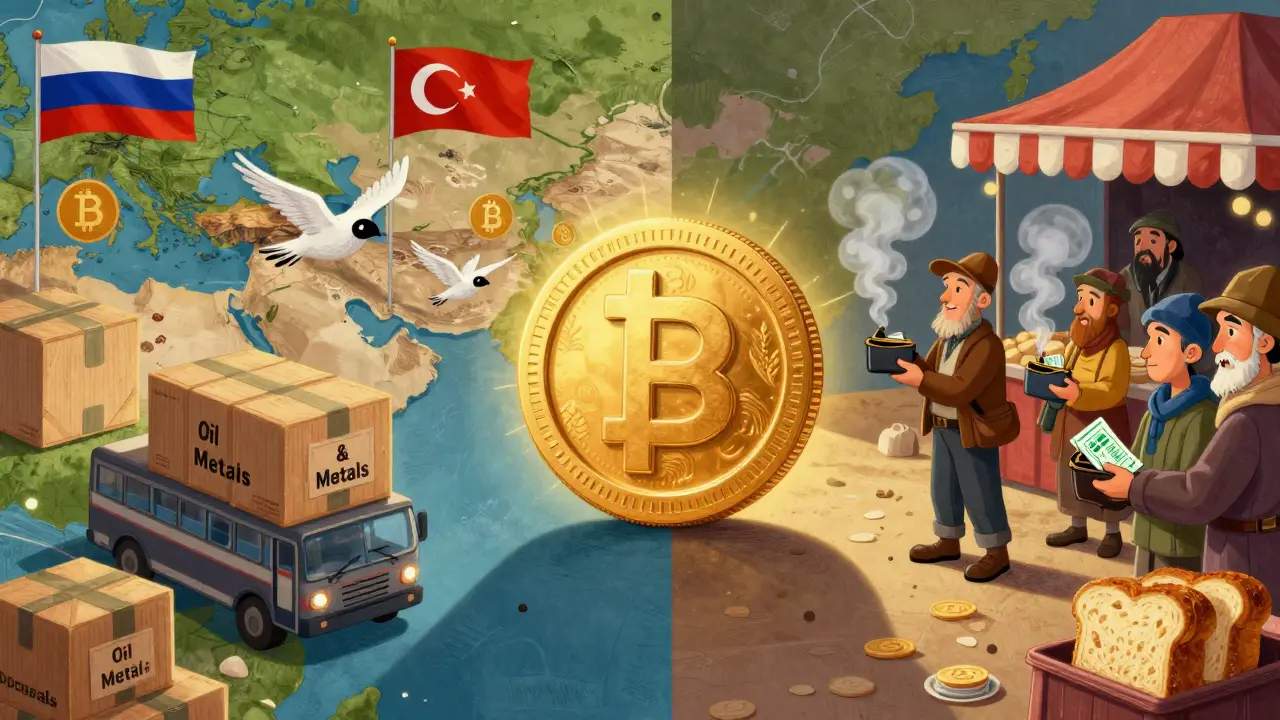
It’s not about buying stuff. It’s about bypassing sanctions. In 2025, Russian companies used cryptocurrency to settle over 1 trillion rubles ($11 billion USD) in international trade. That’s not a coincidence. It’s policy. The government quietly approved this channel to help exporters and importers deal with Western banking restrictions. Russian firms can legally use Bitcoin, Ethereum, or other coins to pay for goods from Turkey, India, or China-but only if they’re part of the experimental regime and their transactions are monitored by authorized financial institutions.This isn’t underground. It’s institutional. Banks and state-backed financial entities act as gatekeepers, ensuring every crypto trade leaves a paper trail. The goal? Keep the ruble strong at home, while using crypto as a tool abroad. It’s a two-tier system: one for the elite, one for the rest.

What About Mining?
Mining is the one area where regular Russians can legally participate. Since 2014, Russia has classified cryptocurrency mining as a legal activity. You don’t need to be a qualified investor. You can set up a rig in your garage, pay your electricity bill, and keep the coins you mine. But here’s the catch: you can’t sell those coins to anyone in Russia. You can’t exchange them for rubles through legal channels. You can’t use them to pay for anything domestically.So mining is allowed-but only as a way to accumulate assets you can’t touch. Many miners sell their coins overseas, often through peer-to-peer platforms or offshore exchanges. This creates a massive underground market. According to the Russian Association of Cryptoeconomics, AI, and Blockchain, over 12 million Russians hold crypto, with total holdings valued at more than $40 billion. Most of them are breaking the law just by trying to use it.
The Two Russias: Elite vs. Everyday
There’s a clear divide. On one side, you have wealthy investors, state-linked corporations, and sanctioned companies using crypto to move money across borders. They have lawyers, compliance teams, and access to licensed platforms. On the other side, you have millions of ordinary Russians who bought crypto during the 2021-2022 price surge, hoping for financial freedom. Now they’re stuck. They can’t sell legally. They can’t spend it. And if they try to cash out through unofficial channels, they risk being flagged for money laundering.The government doesn’t want to stop them entirely-it just wants to control the flow. That’s why the Treasury proposed easing qualified investor rules in September 2025. Not to help the middle class. But to bring more institutional money into the system, making crypto trading more predictable and profitable for banks and hedge funds.
The Digital Ruble Is the Real Endgame
Everything points to one thing: the digital ruble Russia’s state-controlled CBDC set to launch in September 2026 is the future. Unlike Bitcoin, it’s fully traceable. Every transaction is recorded by the central bank. No anonymity. No decentralization. No risk of capital flight.The CBR has spent years testing the digital ruble. It’s already being used in pilot programs with major retailers and government agencies. When it goes live, it won’t replace cash-it will replace the need for crypto. The government doesn’t want people holding Bitcoin. It wants them holding digital rubles, which it can freeze, monitor, or restrict at will.
What’s Next?
The regulatory landscape is still shifting. The Treasury wants to allow fiat-pegged stablecoins-like USDT or USDC-but only if they’re issued by Russian-approved entities. The Central Bank still opposes them, fearing they’ll undermine the ruble. The debate is ongoing. Meanwhile, crypto-related legislation remains fragmented. There’s no dedicated law for Bitcoin or Ethereum. Just patchwork rules under the 2021 Digital Financial Assets Act.Expect more restrictions on domestic crypto use, not fewer. The government’s priority isn’t innovation-it’s control. Crypto is a tool for international trade, not a financial revolution. And for most Russians, it remains a locked vault: you can own it, but you can’t touch it.
Can I legally buy cryptocurrency in Russia?
Yes, you can legally buy cryptocurrency in Russia-but only if you qualify as an "especially qualified investor" with over ₽100 million in assets and ₽50 million in annual income. Ordinary citizens can purchase crypto through unofficial channels, but those transactions have no legal protection and may trigger scrutiny from financial regulators.
Can I use Bitcoin to pay for goods in Russia?
No. Using cryptocurrency for any domestic payment-whether buying a phone, paying rent, or tipping a waiter-is illegal. The Russian ruble (and soon, the digital ruble) is the only legal tender. Any attempt to use crypto for transactions between Russian residents violates the 2021 Digital Financial Assets law and can lead to fines or asset freezes.
Is cryptocurrency mining legal in Russia?
Yes. Mining has been legal since 2014 and is one of the few crypto-related activities open to ordinary citizens. You can operate mining rigs at home or in industrial facilities. However, you cannot legally convert mined coins into rubles within Russia. Most miners sell their output through offshore exchanges or peer-to-peer networks.
Why does Russia allow crypto for international trade but not domestically?
Russia uses cryptocurrency as a workaround for Western financial sanctions. By allowing crypto settlements in international trade, Russian companies can bypass blocked banking systems and continue exporting oil, metals, and machinery. Domestically, the government fears crypto could erode control over the ruble, trigger capital flight, or weaken tax collection. The digital ruble is designed to replace crypto’s role-not compete with it.
What happens if I get caught using crypto for payments in Russia?
If you’re caught using cryptocurrency for domestic payments, you could face administrative penalties, including fines, asset freezes, or forced conversion of crypto holdings into rubles at market rates. In extreme cases, especially if large sums are involved, authorities may investigate for money laundering or violations of currency control laws. Enforcement is selective, but the risk is real.
Will the digital ruble replace Bitcoin in Russia?
Yes, that’s the clear goal. The digital ruble isn’t meant to coexist with Bitcoin-it’s meant to make Bitcoin irrelevant inside Russia. Unlike decentralized crypto, the digital ruble gives the state full control: it can track every transaction, limit spending, and even freeze accounts. The government sees crypto as a tool for foreign trade, not domestic finance. The digital ruble is its answer to the future of money.

Rebecca Andrews
I'm a blockchain analyst and cryptocurrency content strategist. I publish practical guides on coin fundamentals, exchange mechanics, and curated airdrop opportunities. I also advise startups on tokenomics and risk controls. My goal is to translate complex protocols into clear, actionable insights.
19 Comments
-
Deborah Robinson
February 27, 2026 AT 21:02I can’t believe how intentionally cruel this system is. People mined crypto during the pandemic hoping for a way out, and now they’re trapped. The government doesn’t care if you’re broke or rich-it just wants to make sure no one escapes its grip. The digital ruble is just a digital leash.
-
Michelle Mitchell
February 28, 2026 AT 00:48so like... you can mine but not spend? thats wild. like you built a car but cant drive it. why even let people mine then? just to make the rich richer? this feels like a scam designed by a bureaucrat who hates fun
-
Kaitlyn Clark
March 1, 2026 AT 03:47This is capitalism with a side of authoritarianism 🤡 The rich get to play with crypto like a toy to dodge sanctions. Meanwhile, regular folks are treated like criminals for owning digital assets. The digital ruble? More like the digital prison. I’m not surprised. 😒
-
christopher luke
March 2, 2026 AT 11:44Honestly? I think this is the most realistic crypto policy I’ve seen. You can’t let decentralized money compete with your national currency if you want to survive sanctions. Russia’s not trying to be Bitcoin-friendly-it’s trying to survive. And honestly? Kinda smart.
-
Mary Scott
March 3, 2026 AT 09:51This is all a setup. The government is using crypto to funnel money out while locking people in. They’re not afraid of Bitcoin-they’re afraid of people realizing they don’t need the state to be rich. Mark my words: the digital ruble will be used to freeze accounts during protests. This isn’t finance. It’s control.
-
Shannon Holliday
March 4, 2026 AT 16:59The irony is thick here. Russia lets crypto flow out to bypass sanctions but blocks it from flowing in for citizens. It’s like letting your neighbor borrow your car to go to work but telling you you can’t use it to get groceries. The digital ruble is just the state’s version of a credit card with a GPS tracker. 🤦♀️
-
Jeremy buttoncollector
March 5, 2026 AT 04:30The structural asymmetry here is a textbook case of state capture. The regulatory architecture doesn’t merely restrict access-it reifies a dual-tiered financial ontology where capital mobility is commodified for institutional actors while the proletariat is subjected to asset immobilization. The digital ruble is not a CBDC-it’s a sovereign liquidity lock-in mechanism.
-
Michelle Xu
March 5, 2026 AT 05:28The legal framework makes sense from a macroeconomic standpoint. If you’re under sanctions, you need a way to conduct international trade without relying on Western banking. But the domestic restrictions? They’re not about economics-they’re about power. The digital ruble isn’t replacing cash. It’s replacing autonomy.
-
Amanda Markwick
March 7, 2026 AT 00:14I used to think crypto was about freedom. Now I see it’s just another tool for the powerful to stay powerful. Russia’s doing what every authoritarian regime does-they let you own something, but never use it. The digital ruble? It’s the future. And it’s terrifying. But hey, at least we’re all getting a lesson in how money really works.
-
Sriharsha Majety
March 8, 2026 AT 05:22mining is legal but you cant cash out? wow. so its like getting paid in gold but cant sell it. i feel for the miners. they work hard and get nothing. but at least they can mine. i wish india had such clear rules
-
Tabitha Davis
March 8, 2026 AT 07:42Oh my god this is the most ridiculous thing I’ve ever read. So you can own crypto but not use it? That’s not policy-that’s psychological torture. They’re basically saying ‘here’s a diamond, now lick it and pretend it’s satisfying.’ I need a nap.
-
Vishakha Singh
March 9, 2026 AT 08:26This is actually a very balanced approach. International trade needs flexibility, and domestic stability requires control. The digital ruble is the logical next step. Instead of fighting crypto, Russia is channeling its energy into something sustainable. This is statecraft, not oppression.
-
Don B.
March 9, 2026 AT 23:17So the rich get to trade crypto like it’s stocks and the rest of us are stuck with digital Monopoly money? Wow. This is why I hate systems. It’s not about fairness. It’s about who you know. I bet the guys running this are sipping champagne in Zurich right now.
-
Arya Dev
March 11, 2026 AT 01:00Wait... wait... you can mine... but you can't spend? What? What is this? This isn't a policy. This is a glitch. A glitch in the matrix. Who designed this? A 12-year-old? Why even let people mine? Just to watch them cry? I'm confused. I need a diagram. I need a therapist.
-
Leslie Cox
March 12, 2026 AT 18:28This is exactly what happens when you let technocrats run economics. They don’t care about people-they care about control. The digital ruble? It’s not progress. It’s the end of financial privacy. And the fact that they let billionaires play with crypto while regular people are punished? That’s not capitalism. That’s feudalism with a blockchain logo.
-
Andrew Hadder
March 13, 2026 AT 05:44I think this is actually smarter than it looks. Sanctions are brutal. If you’re trying to keep your economy alive, you need loopholes. Crypto for trade, ruble for home. It’s not perfect, but it’s pragmatic. The digital ruble is the real win-it gives the state control without killing innovation.
-
Derek Sasser
March 14, 2026 AT 04:38The fact that mining is legal but spending isn’t? That’s genius in a twisted way. It keeps the energy flowing and the miners working, while keeping the ruble dominant. The digital ruble isn’t replacing crypto-it’s replacing the need for people to trust it. Smart. Cold. Effective.
-
Neeti Sharma
March 14, 2026 AT 08:02Russia is the only country with guts. Letting crypto out while locking it in? That’s not hypocrisy. That’s strategy. The west wants to destroy us. We use their tools against them. Digital ruble? Good. Let them think we’re backward. We’ll be rich while they beg for oil.


Write a comment
More Articles

Everything You Need to Know About the Moniwar Super Rare Pets Airdrop (MOWA)
Discover how to claim Moniwar's Super Rare Pets airdrop, eligibility rules, safety tips, and post‑claim benefits in this comprehensive guide.


Kristi Emens
February 27, 2026 AT 04:58This is such a clear example of how governments use crypto as a tool, not a revolution. It’s not about freedom-it’s about control. The elite get to hedge against sanctions while everyone else is stuck holding digital dust. The digital ruble isn’t innovation; it’s surveillance with a user interface.