
Smart contracts were supposed to be the future of trustless automation-code that runs exactly as written, without intermediaries. But from the very beginning, they’ve been a magnet for hackers. Since 2014, over $3 billion has been stolen through smart contract exploits. These aren’t random glitches. They’re systemic failures in how code was written, reviewed, and deployed. And each major hack didn’t just cost money-it changed how the entire blockchain industry thinks about security.
The DAO: The Hack That Split Ethereum
In June 2016, a flaw in The DAO’s code let attackers drain $50 million in Ether. The DAO was a decentralized venture fund built on Ethereum, meant to let token holders vote on investments. But one function-splitDAO-allowed recursive calls. Attackers kept calling it before the system could update balances, siphoning off funds faster than the network could react.
The Ethereum community faced a choice: let the theft stand, or reverse it. They chose to hard fork the blockchain, creating Ethereum (ETH) and Ethereum Classic (ETC). It was the first time a blockchain was altered to undo a transaction. The move was controversial-some saw it as necessary justice, others as a betrayal of decentralization. But it proved one thing: smart contracts aren’t immutable if the community decides to override them.
Coincheck: The $532 Million Hot Wallet Disaster
While not a smart contract hack, the January 2018 theft of $532 million in NEM from Japan’s Coincheck exchange set the tone for how exchanges handle security. The stolen coins weren’t locked in cold storage-they sat in a hot wallet with no multi-signature protection. The breach forced regulators in Japan to demand stricter custody rules. Exchanges had to stop using hot wallets for large holdings, or face shutdowns.
It was a wake-up call: even if your smart contracts are perfect, your infrastructure isn’t. A single misconfigured wallet can wipe out more than a dozen buggy contracts combined.
Wormhole: The $326 Million Minting Flaw
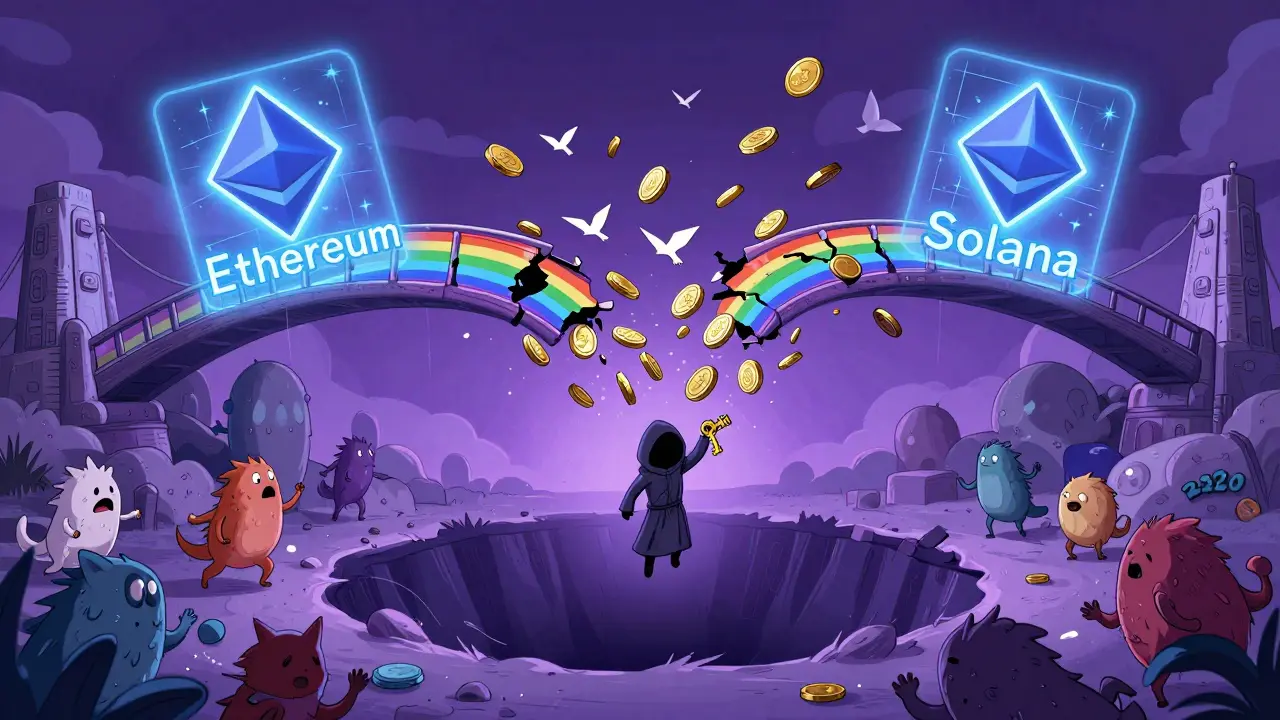
February 2022. Wormhole, a cross-chain bridge connecting Ethereum and Solana, updated its code. One line changed: a signature check was removed. That’s all it took. Attackers exploited it to mint 120,000 wrapped Ether (wETH)-without depositing any real Ether. They swapped the fake tokens for $250 million in actual ETH on decentralized exchanges.
Wormhole offered the hacker $10 million to return the funds and reveal the exploit. The hacker didn’t respond. The bridge was offline for days. The incident exposed how cross-chain bridges are the weakest link in DeFi. They connect two secure blockchains, but the bridge itself becomes a single point of failure. Since then, every new bridge has faced intense scrutiny before launch.
Nomad Bridge: The Digital Mob Looting
August 2022. Nomad Bridge had a simple bug: a function didn’t validate the amount being withdrawn. One user exploited it to pull out $1. Instead of keeping quiet, they posted the exploit on Twitter. Within hours, hundreds of people rushed to drain the bridge. In under three hours, $190 million vanished.
This wasn’t a sophisticated hack. It was crowd-sourced theft. People didn’t need to write code-they just clicked buttons. The community split: some called it justice against a poorly audited project. Others said it proved DeFi’s moral vacuum. Nomad never recovered. The bridge was abandoned. The lesson? If a vulnerability is public, it’s already exploited. There’s no such thing as a quiet fix.
Polynetwork: The Hacker Who Returned 0 Million
In August 2021, a hacker stole $611 million from Polynetwork, another cross-chain bridge. But then, something unexpected happened. The hacker started returning the funds. Eventually, over $560 million was sent back. The hacker claimed they did it "for fun," to prove the system was vulnerable.
Some called it a white hat. Others suspected it was a distraction to avoid prosecution. The hacker never revealed their identity. But the incident forced every DeFi project to rethink their bug bounty programs. If a hacker can steal half a billion and return it, why wouldn’t they just keep it? The answer: because they’re not always rational. And that unpredictability is the real danger.
Ronin Network: $625 Million and the North Korean Hackers
The biggest smart contract hack in history happened in March 2022. Ronin Network, the bridge behind the popular game Axie Infinity, lost $625 million in ETH and USDC. The attackers weren’t random coders. They were the Lazarus Group, a North Korean state-sponsored hacking team.
How did they do it? They compromised five of the nine validator nodes that secured the bridge. Once they had control, they signed fraudulent withdrawal requests as if they were legitimate. The bridge had no emergency pause button. No multi-sig timeout. No human oversight.
Afterward, the U.S. Treasury sanctioned the wallets used in the attack. It was the first time a government froze crypto addresses tied to a state actor. Ronin rebuilt with stricter controls, but the damage was done. Axie Infinity’s economy never fully recovered. And it proved that nation-states now see crypto as a battlefield.
Binance BNB Bridge: $569 Million and a Flawed Token Standard
In October 2022, Binance’s own BNB Chain bridge was hacked for $569 million. Attackers exploited a flaw in how the bridge handled token approvals. They created fake BNB tokens and withdrew real ones. The bridge trusted the token contract’s balance without verifying the source.
Binance responded by freezing withdrawals and launching a forensic investigation. But the damage was already done. The incident showed that even the biggest players aren’t immune. Binance had one of the most experienced teams in crypto-and they still missed it.
Why Do These Hacks Keep Happening?
After The DAO, experts said, "We’ll fix this." But the industry kept moving fast. Startups rushed to launch DeFi apps. Investors chased yields. Audits became checkboxes. Many projects spent less than $10,000 on security reviews. Some didn’t audit at all.
OpenZeppelin, the leading smart contract library provider, found that nearly half of all DeFi projects in 2016 had critical flaws. Today, even well-funded projects still make the same mistakes:
- Using outdated code without checking for known vulnerabilities
- Skipping testnet deployments
- Not using multi-signature wallets for critical functions
- Ignoring time-locked upgrades
- Assuming users won’t exploit obvious bugs
Flash loans made things worse. Attackers can borrow millions in seconds to manipulate prices, drain liquidity pools, or trigger reentrancy bugs. Oracle manipulation lets hackers feed false data to contracts-like pretending ETH is worth $1 instead of $3,000. Governance attacks let bad actors buy up voting tokens and steal funds legally.
What’s Changed Since Then?
Security isn’t optional anymore. Leading protocols now spend 15-20% of their budget on audits. Firms like Trail of Bits and ConsenSys Diligence charge $100,000 to $500,000 for a full audit. Formal verification tools like Certora and SMT solvers are now standard for high-value contracts.
Multi-signature wallets are required for treasury withdrawals. Time-locked upgrades mean changes can’t be made instantly. Bug bounties pay up to $10 million for critical flaws. Some protocols now use insurance pools backed by tokenized coverage.
But the biggest shift? Mindset. Developers now assume their code will be attacked. They write for the worst-case scenario. They don’t trust user input. They don’t trust external contracts. They don’t trust their own assumptions.
What Should You Do?
If you’re using DeFi:
- Never put more money into a protocol than you’re willing to lose
- Use hardware wallets-never connect your main wallet to unknown dApps
- Check if a project has been audited by a reputable firm (OpenZeppelin, CertiK, Trail of Bits)
- Look for multi-sig governance and time-locked upgrades
- Avoid new bridges unless they’ve been live for at least 6 months
If you’re building a smart contract:
- Use OpenZeppelin’s audited libraries, don’t write your own token logic
- Run your contract through Slither or MythX before deployment
- Deploy on testnet for at least 30 days
- Require at least 3-of-5 multi-sig for critical functions
- Set up a bug bounty program on Immunefi
The Future Isn’t About Fixing Bugs-It’s About Accepting Risk
Smart contract hacks aren’t going away. They’re getting more complex, not less. As DeFi grows, so do the incentives for attackers. AI-powered exploit tools are already being tested. Automated systems can scan thousands of contracts in minutes and find flaws humans miss.
But here’s the truth: blockchain’s power comes from its openness. You can’t lock it down without killing its purpose. The answer isn’t perfect security-it’s better risk management. Insurance. Decentralized backups. User education. And a culture that treats code like a weapon, not a toy.
The hacks of the past didn’t break blockchain. They forced it to grow up. And if you’re still treating smart contracts like magic spells that just work? You’re already behind.
What was the biggest smart contract hack ever?
The largest smart contract hack was the Ronin Network breach in March 2022, where $625 million in Ether and USDC was stolen by the North Korean Lazarus Group. The attack exploited compromised validator nodes on the cross-chain bridge, allowing attackers to sign fraudulent withdrawals without authorization.
How did The DAO hack change Ethereum?
The DAO hack led to a hard fork of the Ethereum blockchain in 2016, splitting it into Ethereum (ETH), which reversed the theft, and Ethereum Classic (ETC), which kept the original chain. This was the first time a blockchain community voted to undo a transaction, setting a precedent for governance and raising debates about decentralization versus security.
Why are cross-chain bridges so vulnerable?
Cross-chain bridges connect two secure blockchains but rely on complex, centralized-looking smart contracts to lock and release assets. They often use a small number of validators, lack proper signature checks, and have no emergency pause mechanisms. Since they handle large sums and are newer than core protocols, they’re targeted more often and audited less thoroughly.
Can smart contracts ever be truly secure?
No smart contract can be 100% secure. Even the most rigorously audited code can have unknown flaws. The goal isn’t perfection-it’s resilience. Use trusted libraries, enforce multi-sig controls, deploy on testnets, monitor for unusual activity, and assume your contract will be attacked. Security is an ongoing process, not a one-time audit.
What should I look for before using a DeFi protocol?
Check if the protocol has been audited by a reputable firm like OpenZeppelin, Trail of Bits, or CertiK. Look for multi-signature governance, time-locked upgrades, and a public bug bounty program. Avoid protocols with no audit history, anonymous teams, or sudden large token unlocks. If it sounds too good to be true, it probably is.

Rebecca Andrews
I'm a blockchain analyst and cryptocurrency content strategist. I publish practical guides on coin fundamentals, exchange mechanics, and curated airdrop opportunities. I also advise startups on tokenomics and risk controls. My goal is to translate complex protocols into clear, actionable insights.
24 Comments
-
SeTSUnA Kevin
December 18, 2025 AT 03:12The DAO fork wasn’t a solution-it was a surrender. Decentralization isn’t a slogan. It’s a covenant. Breaking it for convenience erodes the entire premise.
ETC exists because some of us still believe in immutability. The rest? They just wanted their money back. -
Madhavi Shyam
December 19, 2025 AT 21:48Wormhole’s flaw was a classic access control violation-missing validation on the _msgSender() context. No multi-sig, no pause, no fallback. Classic DeFi antipattern.
And yes, cross-chain bridges are single points of failure by design. They’re trust-minimized in theory, trust-maximized in practice. -
Sean Kerr
December 21, 2025 AT 11:54brooooooo... i just lost 3k in a rug pull last week and i’m still crying in my hoodie 😭
why do people think crypto is ‘free money’?? it’s like playing russian roulette with your bank account… and the gun’s loaded with a 100% chance of exploding 😭😭😭 -
Sue Bumgarner
December 21, 2025 AT 20:15Let’s be real-this whole ‘DeFi revolution’ is just Wall Street’s next Ponzi scheme with blockchain glitter on it.
Why do you think the U.S. government didn’t shut this down yet? Because they’re IN IT. They want you to lose money so they can buy the assets cheaper.
And don’t tell me ‘it’s decentralized.’ The SEC has been quietly talking to every major auditor since 2020. They’re setting the trap. -
Kayla Murphy
December 22, 2025 AT 22:19Hey, if you’re just starting out in DeFi, don’t panic. Learn one thing at a time.
Start with a hardware wallet. Check audits on Immunefi. Don’t rush into new bridges. You don’t need to be a genius-you just need to be careful.
You got this. 💪 -
Florence Maail
December 24, 2025 AT 01:32They say ‘code is law’… but what if the code was written by someone who got paid in crypto and never graduated high school?
And don’t tell me about ‘community governance’-the real owners are the VCs who bought 70% of the tokens before launch.
Also… anyone else think the Ronin hack was a false flag? Like… maybe the U.S. did it to justify crypto regulation?
Just saying. 🤔 -
Chevy Guy
December 24, 2025 AT 22:34Smart contracts are just glorified Excel macros with a blockchain sticker on them
People act like they’re magic but they’re not
And the auditors? They’re paid by the same people who wrote the code
So yeah… it’s all a joke
crypto is a pyramid scheme with better branding -
Kelsey Stephens
December 26, 2025 AT 12:55I read this whole thing and I just want to say: thank you for writing this so clearly.
It’s easy to feel overwhelmed when you’re new to crypto. But this isn’t about fear-it’s about awareness.
If you’re learning, you’re already ahead of 90% of the people losing money out there.
Keep going. You’re not alone. -
Amy Copeland
December 27, 2025 AT 01:44Oh wow, you actually listed real hacks? How quaint.
Did you forget to mention the 12 other bridges that vanished without press coverage?
And ‘reputable’ audits? Please. The only thing OpenZeppelin audits is their PR team’s ego.
This article reads like a whitepaper written by someone who got paid in ETH and hasn’t touched a keyboard since 2021. -
Patricia Amarante
December 28, 2025 AT 00:43Y’all are overthinking this. Just use MetaMask. Don’t connect to sketchy sites. If it’s got a 100k bounty, it’s probably safe.
And if you’re still holding all your crypto on an exchange? You’re already losing.
Simple. Done. -
Timothy Slazyk
December 29, 2025 AT 10:27What we’re seeing isn’t just technical failure-it’s philosophical failure.
We built systems that assume perfect rationality in a world of human greed, panic, and curiosity.
The DAO hack didn’t expose a bug. It exposed our belief that people would act ethically when given power.
And now? We’ve replaced that faith with bureaucracy: multi-sigs, timelocks, insurance pools.
But the real question remains: can we ever engineer trust? Or are we just building increasingly elaborate cages for our own naivety? -
Mark Cook
December 30, 2025 AT 17:50Actually, the biggest hack was the Binance BNB bridge-but nobody talks about it because Binance owns the media.
And the ‘$625M Ronin hack’? That was just a distraction.
The real theft? The $2 billion in lost liquidity from failed yield farms nobody ever reports.
They don’t call it a hack. They call it ‘impermanent loss.’
Same thing. Different PR. -
Jack Daniels
January 1, 2026 AT 13:47Why do I even bother reading this?
I know what’s coming.
I’ve seen it before.
They’ll say ‘learn’ and ‘be careful’
And then next week, another bridge collapses
And I’ll still be here… watching
Waiting
For the next one to fall -
Samantha West
January 1, 2026 AT 20:26One must contemplate the ontological implications of immutability in distributed systems when the social contract supersedes the cryptographic one.
Is a blockchain truly decentralized if its governance can be swayed by a 51% vote of token holders who are, in fact, centralized entities?
The DAO fork was not a technical decision-it was a metaphysical rupture.
And we are still living in its aftershock. -
Craig Nikonov
January 3, 2026 AT 14:19North Korean hackers? Please. They’re just the tip of the iceberg.
The real thieves? The VCs who dumped their tokens the day after the Ronin hack.
And the auditors? They’re all part of the same LinkedIn network.
And don’t get me started on how the SEC’s ‘regulation’ is just a backdoor for institutional control.
It’s all a game. And we’re the pawns. -
Donna Goines
January 4, 2026 AT 10:10Everyone’s acting like this is new.
Remember the Mt. Gox collapse? 850k BTC gone.
Remember Bitconnect? ‘Lending’ that was just a Ponzi.
This isn’t crypto’s fault. It’s human nature.
People will always find a way to turn trust into theft.
And now they’re doing it with smart contracts instead of fake websites.
Same story. New costumes. -
Greg Knapp
January 5, 2026 AT 06:19They keep saying ‘learn from the past’
But nobody learns
They just buy the next coin
And the next bridge
And the next ‘guaranteed 500% APY’
And then they cry when it’s gone
Again
Again
Again -
Shruti Sinha
January 5, 2026 AT 15:18Interesting breakdown. The Nomad Bridge incident was wild-people literally just clicked ‘withdraw’ because someone posted a screenshot.
That’s not hacking. That’s social engineering on a global scale.
And honestly? It’s terrifying how fast human behavior can turn a bug into a bank heist. -
Rebecca Kotnik
January 7, 2026 AT 13:38The evolution of smart contract security reveals a profound tension between innovation and institutionalization.
On one hand, we celebrate the radical decentralization of financial systems. On the other, we implement centralized controls-multi-signatures, timelocks, governance councils-to mitigate the very risks that decentralization was meant to eliminate.
This is not hypocrisy. It is adaptation.
But at what cost? If every protocol requires a legal team, a compliance officer, and a third-party auditor to function, have we not recreated the very intermediaries we sought to abolish?
The answer may lie not in perfect code, but in perfect trustlessness-which, ironically, may be unattainable by design. -
Terrance Alan
January 9, 2026 AT 02:03Why do people still think crypto is about technology?
It’s not.
It’s about money.
And money attracts predators.
Every single one of these hacks was inevitable.
The only surprise is that we’re still shocked.
We knew this would happen.
And yet we kept building.
Why?
Because we wanted to believe.
And that’s the real vulnerability. -
Elvis Lam
January 10, 2026 AT 07:43Most people don’t realize: the real lesson isn’t in the hacks-it’s in the recovery.
Wormhole paid a bounty. Polynetwork got most of its money back. Ronin rebuilt with better controls.
That’s not failure. That’s resilience.
Web2 died when it got hacked. Web3? It learns.
And if you’re still scared? Good. Stay scared. Just don’t stop building. -
Jonny Cena
January 10, 2026 AT 13:40Hey-if you’re reading this and you’re new to DeFi, I see you.
You’re probably overwhelmed. Maybe even scared.
That’s okay.
Start small. Use a hardware wallet. Stick to projects with real audits. Ask questions.
You don’t need to know everything today.
Just be curious. Be cautious. And don’t let anyone make you feel stupid for asking.
You’re doing better than you think. -
George Cheetham
January 12, 2026 AT 07:21Every hack teaches us that systems are only as strong as their weakest assumption.
Assume the code is perfect? It’s not.
Assume the team is honest? Maybe not.
Assume the users won’t exploit it? They will.
So we build for failure.
We design for chaos.
And we accept that trust is not a feature-it’s a risk.
And maybe… that’s the only way forward.


Write a comment
More Articles

BigONE Exchange Review 2025: Fees, Security, and Trading features
A comprehensive 2025 review of BigONE crypto exchange covering fees, security, leverage, assets, pros and cons, and step‑by‑step onboarding.

Turkey Crypto Payment Ban: 2021 Regulations and Current Rules Explained
Understand Turkey's crypto payment ban, from the 2021 CBRT regulations to 2025 AML rules. Learn why you can trade but not spend crypto, and how new CASP licenses affect users.

Tunisia's Complete Crypto Ban Explained: Laws, Risks & Future Outlook
Tunisia enforces a strict ban on all cryptocurrency activities, including trading, mining, and payments, with penalties up to five years in prison. Learn about the legal framework, enforcement realities, and potential future changes.
Abby Daguindal
December 16, 2025 AT 04:06Wow. So we’re just supposed to trust code written by people who can’t even spell ‘reentrancy’? I’ve seen more rigor in a middle school science fair.
And don’t get me started on ‘audit’ as a checkbox. That’s not security-that’s performance art.