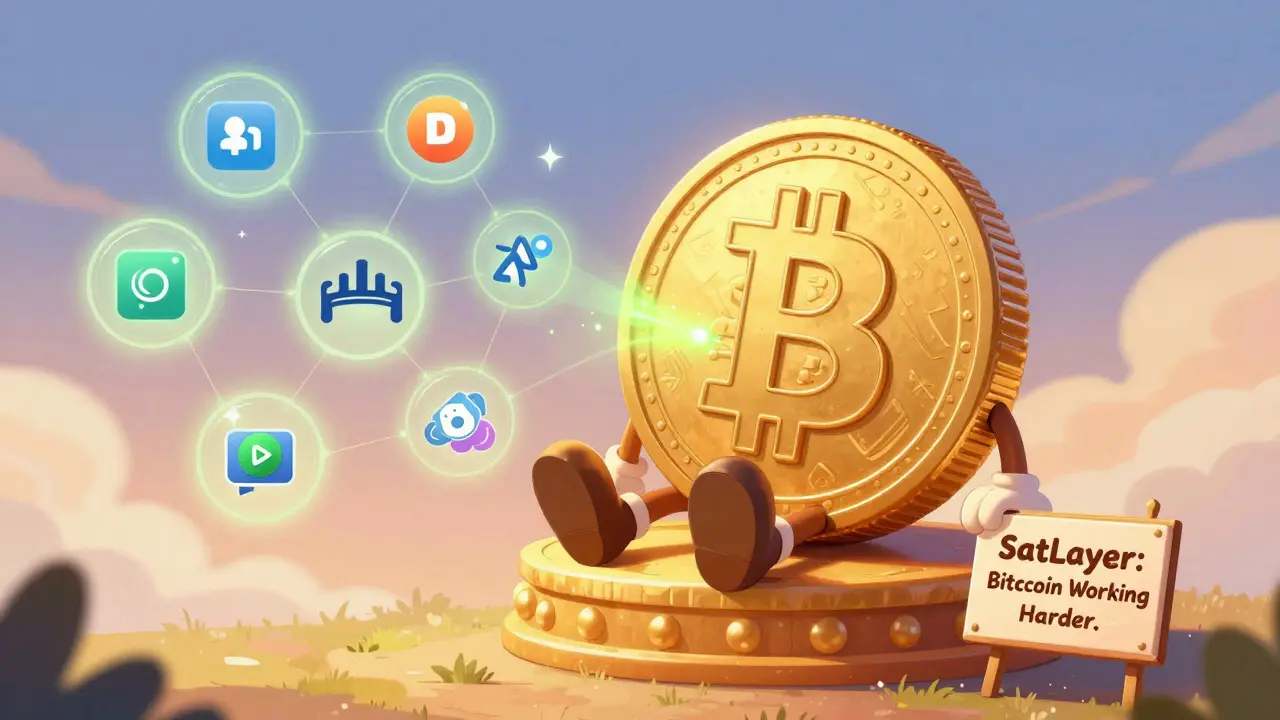
Most people think of Bitcoin as digital gold - something you hold onto, not something you use. But what if your Bitcoin could earn rewards while also helping secure other blockchains? That’s exactly what SatLayer (SLAY) is trying to do. It’s not another altcoin trying to be faster or cheaper. Instead, it’s a new way to make Bitcoin work harder - and get paid for it.
What Exactly Is SatLayer?
SatLayer is a decentralized platform built to turn Bitcoin from a passive store of value into an active, yield-generating asset. It does this through something called Bitcoin restaking. Restaking means using your already-staked Bitcoin to secure more than one blockchain at the same time. Instead of letting your Bitcoin sit idle after staking it on one chain, SatLayer lets you use it to help protect other apps - like DeFi platforms, bridges, or AI systems - and earn extra rewards for doing so. This isn’t magic. It’s built on top of another project called Babylon. Babylon lets you stake Bitcoin without moving it off the Bitcoin network. It uses clever cryptography called extractable one-time signatures (EOTS) to let Bitcoin validators participate in securing other chains while keeping your coins safe in your wallet. But Babylon only handles basic security rules - like stopping a validator from signing two blocks at once. SatLayer adds something Babylon can’t: full programmability.How SatLayer Makes Bitcoin Programmable
Think of Babylon as the foundation of a house. It gives you a solid base. SatLayer is the wiring, plumbing, and smart locks you add on top. SatLayer runs as smart contracts on the Babylon blockchain using CosmWasm - a language that lets developers write complex logic. This means developers can create custom rules for how Bitcoin collateral is used and punished. For example:- A DeFi lending protocol can set a rule: if its oracle feeds wrong price data, then the Bitcoin staked to secure it gets slashed.
- A bridge connecting Bitcoin to Ethereum can require operators to respond within 5 seconds - or lose their staked Bitcoin.
- An AI model that needs real-time data can demand uptime guarantees - and slash collateral if those aren’t met.
What Is the SLAY Token For?
The SLAY token is the fuel that keeps SatLayer running. It has three main jobs:- Incentivizing participation - Bitcoin stakers earn SLAY rewards for securing BVSs. Operators who run nodes get SLAY too.
- Enabling slashing - When an operator fails or cheats, SLAY is used to calculate how much Bitcoin gets taken away (slashed) as punishment.
- Future governance - Eventually, SLAY holders will vote on changes to the protocol: how rewards are distributed, which new services get supported, and where the treasury funds go.
- 45% - Ecosystem growth (grants, developer incentives, user rewards)
- 10% - Community (airdrops, participation programs)
- 20% - Team and early contributors
- 15% - Investors and early backers
- 10% - SatLayer Foundation (for long-term development)

Where Can You Buy SLAY?
SatLayer launched its token on August 12, 2025, with its first listing on Phemex as SLAY/USDT. Since then, it’s been available on a few other exchanges, though trading volume is still modest. As of March 2026:- Price range: $0.00136 to $0.00147 USD (varies by platform)
- 24-hour trading volume: $36K-$154K USD
- Market cap: ~$11.17 million
Who’s Behind SatLayer?
The SatLayer Foundation is the team behind the project. They’re not anonymous - they’ve published documentation, whitepapers, and regular updates. Their biggest win? A strategic partnership with Babylon Labs. SatLayer is the exclusive programmable layer built on Babylon’s infrastructure. That’s huge. Babylon is one of the most technically sound Bitcoin staking protocols out there. SatLayer also has partnerships with major blockchains:- Sui - SatLayer is Sui’s official Bitcoin restaking partner
- Berachain - Used to secure its DeFi ecosystem with Bitcoin collateral

Why This Matters
Bitcoin has over $1 trillion in value locked up. Right now, almost none of it earns yield. SatLayer changes that. It turns Bitcoin into a shared security layer for the entire crypto ecosystem. Instead of each new blockchain needing its own set of validators and token incentives, they can just tap into Bitcoin’s massive security. This isn’t just about earning more crypto. It’s about making the whole system safer. Bitcoin is the most secure network in crypto. By letting it back up DeFi, bridges, oracles, and AI apps, SatLayer reduces the risk of hacks and failures across the whole space.Is SLAY a Good Investment?
That depends on what you’re looking for. If you want a quick pump - probably not. SLAY is too new, too small, and too volatile. Prices swing based on news, exchange listings, or rumors. If you believe Bitcoin should do more than sit in wallets - then SatLayer is one of the most compelling projects out there. It’s not trying to replace Bitcoin. It’s helping it evolve. The fact that it’s built on Babylon, has real partnerships, and has a clear use case makes it more than just a speculative token. Think of it this way: Bitcoin is the bedrock. SatLayer is the first real attempt to build something useful on top of it - without breaking it.What’s Next for SatLayer?
The roadmap is focused on three things:- Expanding the number of Bitcoin Validated Services - more DeFi, more RWA (real-world assets), more AI tools
- Rolling out full on-chain governance - letting SLAY holders vote on protocol upgrades
- Integrating with more blockchains beyond Sui and Berachain
One thing’s clear: SatLayer isn’t trying to be the next Ethereum. It’s trying to be the engine that makes Bitcoin useful again.
Is SatLayer (SLAY) a scam?
No, SatLayer is not a scam. It’s built on the Babylon protocol, which has been audited and is backed by serious blockchain developers. The team has published technical documentation, code repositories, and public updates. The SLAY token is listed on reputable exchanges like Phemex. While it’s still early and risky - like most crypto projects - there’s no evidence of fraud, rug pulls, or hidden team wallets. Always do your own research before investing.
Can I stake Bitcoin directly on SatLayer?
No, you can’t stake Bitcoin directly on SatLayer. SatLayer runs as smart contracts on the Babylon blockchain. To participate, you must first stake your Bitcoin on Babylon. Once staked there, you can then delegate that stake to SatLayer to secure Bitcoin Validated Services and earn SLAY rewards. You never move your Bitcoin off the Bitcoin network - it stays in your wallet the whole time.
How does SatLayer differ from Ethereum staking?
Ethereum staking requires you to lock up ETH to validate blocks on Ethereum. SatLayer doesn’t ask you to stake anything new. Instead, it lets you use your existing Bitcoin - already staked on Babylon - to earn extra rewards by securing other apps. Ethereum uses its own token for security. SatLayer uses Bitcoin’s security to protect other chains. It’s a completely different model: Bitcoin as collateral, not as a chain.
What are Bitcoin Validated Services (BVS)?
Bitcoin Validated Services (BVS) are decentralized applications that use Bitcoin collateral - via SatLayer - to guarantee their security. Examples include DeFi lending platforms, cross-chain bridges, oracles that feed real-world data, and tokenized real estate platforms. These services can set custom rules (like slashing conditions) and rely on Bitcoin’s massive network to punish bad actors. BVSs don’t need their own tokens to attract validators - they use Bitcoin’s existing security.
Why is SatLayer built on Babylon?
Babylon provides the only secure, non-custodial way to stake Bitcoin without moving it off the Bitcoin blockchain. It uses advanced cryptography (EOTS) to let Bitcoin validators participate in securing other chains. SatLayer adds programmability on top of Babylon’s foundation. Without Babylon, SatLayer couldn’t exist. Babylon gives the security. SatLayer gives the flexibility. Together, they make Bitcoin usable for complex applications.
Can I lose my Bitcoin if I use SatLayer?
Yes - but only if the operator you delegate to behaves badly. When you stake Bitcoin through Babylon and use SatLayer, you’re delegating your stake to an operator who secures a service. If that operator fails - like providing wrong data or going offline - the service can slash their collateral. That means part of your staked Bitcoin could be taken as punishment. This is intentional. It’s how security works. To reduce risk, choose operators with strong track records and high reputation scores.
Is SatLayer only for Bitcoin holders?
Yes - but not in the way you think. You don’t need to own SLAY to participate. You need Bitcoin. If you hold Bitcoin and stake it on Babylon, you can earn SLAY rewards. If you’re a developer building a DeFi app, you can use SatLayer to secure your service with Bitcoin collateral - even if you don’t own any SLAY. The token is mainly for governance and incentives. The real value comes from Bitcoin’s security.

Rebecca Andrews
I'm a blockchain analyst and cryptocurrency content strategist. I publish practical guides on coin fundamentals, exchange mechanics, and curated airdrop opportunities. I also advise startups on tokenomics and risk controls. My goal is to translate complex protocols into clear, actionable insights.
17 Comments
-
Cheri Farnsworth
March 15, 2026 AT 02:22Finally someone is building something that respects Bitcoin’s core principles instead of trying to override them
-
Gene Inoue
March 15, 2026 AT 20:33Another crypto bro fantasy. You think Bitcoin staking on other chains is a good idea? Nah. You’re just handing over your BTC to some smart contract that could get hacked tomorrow. Babylon? More like Babble. And SLAY? Sounds like a crypto meme coin with a fancy whitepaper. Don’t fall for this. Bitcoin’s job is to be money, not a utility token for some DeFi circus.
-
Ricky Fairlamb
March 16, 2026 AT 21:28Let’s be clear: this isn’t innovation. It’s entropy dressed up as progress. Babylon’s EOTS is a cryptographic novelty, yes - but it’s built on the assumption that Bitcoin validators can be trusted to act as third-party security providers. That’s a fundamental violation of Bitcoin’s non-custodial ethos. You’re not ‘restaking’ - you’re creating a new attack surface. And SLAY? A token with no intrinsic value, issued by a foundation with 20% allocation to insiders. The 10% for the foundation? That’s a backdoor for centralization. This isn’t decentralization. It’s a permissioned layer over Bitcoin, with a tokenomics model that smells like a 2021 pump. And don’t get me started on the ‘partnerships’ - Sui and Berachain are both centralized messes. This isn’t progress. It’s a house of cards built on a foundation of wishful thinking.
-
Jessica Beadle
March 17, 2026 AT 01:42Restaking Bitcoin via Babylon introduces a non-trivial risk surface - validator liveness, slashing conditions, cross-chain oracle reliability, and the fact that you’re now exposed to the attack vectors of multiple chains, not just Bitcoin. The SLAY token’s role in slashing calculations creates a feedback loop where token price volatility directly impacts collateral security. That’s not a feature - it’s a systemic flaw. And the fact that 25% of community allocation has been distributed without lockups? That’s a liquidity dump waiting to happen. This isn’t DeFi innovation. It’s a regulatory minefield wrapped in a whitepaper.
-
Angelica Stovall
March 17, 2026 AT 17:31Why would anyone risk their Bitcoin on some new chain? Bitcoin’s supposed to be safe. This just makes it risky. And SLAY? Worthless. People are just gambling. Don’t be fooled.
-
Taylor Holloman.
March 17, 2026 AT 22:54I’ve been watching Bitcoin for over a decade, and honestly? This is one of the first things that made me feel excited again. Not because it’s going to make me rich - but because it feels like Bitcoin is finally being used the way it was meant to: as a bedrock, not a relic. The fact that you can keep your coins in your wallet while they help secure DeFi apps? That’s elegant. I don’t love the tokenomics, and I’m wary of the team’s allocation - but the core idea? It’s beautiful. I’ve staked a small amount just to see how it works. Not for profit. For curiosity. And honestly? It’s kind of magical.
-
Bryan Roth
March 18, 2026 AT 10:41If you’re holding Bitcoin and not exploring SatLayer, you’re leaving money on the table - and more importantly, you’re missing out on helping make the whole ecosystem safer. This isn’t about speculation. It’s about contributing. Bitcoin’s security is the most valuable thing in crypto. Why let it sit idle? By using Babylon + SatLayer, you’re not just earning SLAY - you’re strengthening the entire web of decentralized apps. Think of it like lending your car to a rideshare network. You still own it. You still control it. But now it’s doing more. That’s not risky. That’s responsible. And if you’re a dev? Build on it. The tools are open. The infrastructure is live. The future isn’t coming - it’s already here. Just waiting for you to show up.
-
sai nikhil
March 19, 2026 AT 06:07Interesting concept. Bitcoin’s security is unmatched. Using it to secure other chains is logical. But I am curious - how does SatLayer handle validator downtime or network congestion on Babylon? Is there a penalty mechanism for partial failures? And how does SLAY inflation affect long-term staking incentives? The technical depth is promising, but real-world reliability matters more than whitepaper promises.
-
Sahithi Reddy
March 19, 2026 AT 09:00Bitcoin staking on other chains? Yes. Why not. SLAY is small but real. I’m in.
-
George Hutchings
March 21, 2026 AT 08:19From India, I’ve seen a lot of crypto hype. But SatLayer? It’s different. Bitcoin isn’t just a currency here - it’s a hedge. And this lets people use their BTC without selling. That’s huge. No need to convert to USDT or ETH. Just stake. Earn. Stay safe. I’ve told three friends already. This could be the bridge between Bitcoin’s stability and DeFi’s innovation. Simple. Powerful. Real.
-
Henrique Lyma
March 22, 2026 AT 03:01Another ‘Bitcoin as collateral’ scheme. You’re telling me I should risk my BTC because some smart contract says so? The fact that this is built on Babylon - which itself is a layer over Bitcoin - means you’re adding complexity to a system that was designed to be simple. Bitcoin’s strength is its simplicity. This? It’s overengineered. And SLAY? A token with no utility beyond governance. Who needs governance when you’re already trusting a third-party chain? This isn’t innovation. It’s a tax on naivety.
-
Steph Andrews
March 22, 2026 AT 19:34I like how this doesn’t force people to sell their Bitcoin. That’s rare. Most projects want you to swap your BTC for their token. This just lets you use what you already have. I’m not rich, but I have a few BTC. This feels like a way to make them work without losing them. I don’t care about SLAY price. I care about safety. And if it helps secure bridges and DeFi apps? That’s good for everyone. I’m not shouting from the rooftops. But I’m watching. And I’m impressed.
-
Prakash Patel
March 23, 2026 AT 12:49Everyone’s excited about this but nobody talks about the elephant in the room - what happens if Babylon gets hacked? Or if the EOTS signature scheme has a flaw? You’re betting your Bitcoin on someone else’s code. And SLAY? It’s not even listed on Binance. That says everything.
-
Zachary N
March 23, 2026 AT 17:59For anyone new to this: SatLayer isn’t a staking platform - it’s a permission layer. You don’t stake BTC on SatLayer. You stake on Babylon first. Then you delegate that stake to SatLayer. Think of it like renting out your parking spot. You still own the spot. You still control access. But now you’re letting someone else use it - and you get paid for it. The SLAY rewards are just the payment. The real value? Your BTC is now backing real-world applications - not just sitting there. That’s huge. And yes, there’s risk. If the operator you delegate to misbehaves, part of your stake could be slashed. But that’s the point. It’s a market-based incentive system. Choose reputable operators. Check their uptime stats. Don’t just pick the highest APY. This isn’t a lottery. It’s a system. And if you treat it like one, you’ll do fine. I’ve been using it for six months. No issues. Just steady rewards. And honestly? It’s nice to feel like my BTC is doing something.
-
Kira Dreamland
March 24, 2026 AT 17:52Love that this lets Bitcoin holders earn without selling. I’ve been staking for months now. SLAY rewards are small but consistent. And I never had to move my coins. That’s peace of mind. Also, the fact that devs can build custom slashing rules? That’s next-level. My favorite use case: a bridge that slashes if it doesn’t respond in 5 seconds. That’s not just smart - it’s necessary. This is the quiet revolution nobody’s talking about.
-
Billy Karna
March 26, 2026 AT 04:03Just saw someone say ‘what if Babylon gets hacked?’ - that’s a fair concern, but it’s not how this works. Babylon isn’t a single chain. It’s a network of Bitcoin validators signing off on attestations. Even if one validator goes rogue, the rest can slash them. It’s decentralized by design. And SatLayer’s slashing rules are enforced by the BVS protocols themselves - not by a central authority. So if a bridge gets hacked? The slashing is triggered by the bridge’s own logic. Your BTC isn’t at risk because Babylon failed. It’s at risk because the service you’re securing failed. That’s the whole point. It’s not a security layer - it’s a responsibility layer. You’re not trusting Babylon. You’re trusting the service. And you’re being rewarded for helping keep it honest.


Write a comment
More Articles

Swash App Launch & CoinMarketCap Airdrop: Full 2025 Details
Learn how to join the Swash app launch, understand the rumored CoinMarketCap airdrop, and start earning SWASH tokens with step‑by‑step instructions.


Billy Karna
March 13, 2026 AT 10:32SatLayer is one of those rare projects that actually makes sense in the context of Bitcoin’s long-term role. Most people think of Bitcoin as a store of value, but that’s like calling the internet a digital library - it’s technically true, but misses the point. Bitcoin’s security is the most robust in crypto history, and SatLayer leverages that without moving a single satoshi off-chain. Babylon’s EOTS tech is genius - it lets Bitcoin validators sign off on other chains without ever touching private keys. That’s not just clever, it’s revolutionary. SatLayer adds programmability on top of that, letting DeFi protocols, bridges, and oracles set slashing conditions based on Bitcoin collateral. Imagine a bridge that slashes your staked BTC if it doesn’t respond within 5 seconds. That’s not theoretical - it’s live. And the SLAY token isn’t just a governance token; it’s the economic glue that ties incentives together. The 2.1B supply matching Bitcoin’s satoshis? That’s poetic. This isn’t another altcoin. It’s Bitcoin evolving into infrastructure.
Most projects try to replace Bitcoin. SatLayer makes Bitcoin indispensable.