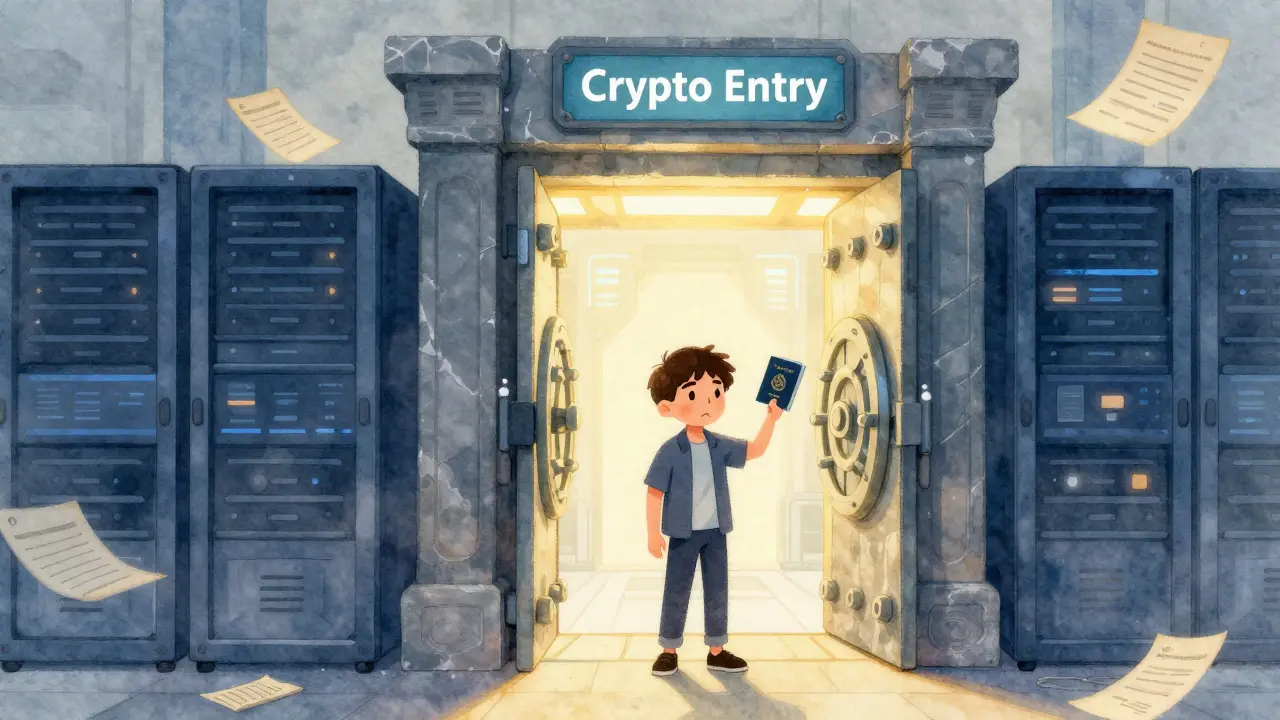
You’ve probably seen it before: you sign up for a new cryptocurrency exchange, ready to buy your first Bitcoin or Ethereum, and suddenly the screen asks for a photo of your passport. It feels intrusive. It feels like banking from the 1990s, not the futuristic world of digital assets. This process is called Know Your Customer (KYC), and it has become the unavoidable gatekeeper between you and the mainstream crypto market.
If you are wondering why this happens, who enforces it, and whether there are ways around it, you are not alone. As we move through mid-2026, the landscape of crypto identity verification has shifted dramatically. The days of completely anonymous trading on major platforms are largely over. Understanding KYC is no longer just about compliance; it is about understanding how your data is used, how your funds are protected, and what options remain if you value privacy above all else.
The Origin Story: From Banks to Blockchains
To understand why your face is now required to buy a token, we have to look back at traditional finance. Know Your Customer (KYC) did not start with blockchain. It originated from the Bank Secrecy Act (BSA) of 1970 in the United States. The goal was simple: prevent banks from being used as conduits for money laundering and terrorist financing.
The real turning point for crypto came in 2013 when the U.S. Treasury’s Financial Crimes Enforcement Network (FinCEN) issued guidance stating that virtual currency exchangers qualify as money transmitters under the BSA. This classification meant that if you ran an exchange, you had to follow the same rules as a bank. By 2014 and 2015, major platforms began implementing these checks. Today, the Financial Action Task Force (FATF), an intergovernmental body established in 1989, pushes these standards globally. Their 2019 update specifically targeted Virtual Asset Service Providers (VASPs), mandating that crypto exchanges implement KYC procedures equivalent to traditional financial institutions.
This regulatory pressure explains why almost every major platform you use today requires verification. It is not because the companies love collecting your data; it is because they want to stay in business.
How Crypto KYC Actually Works
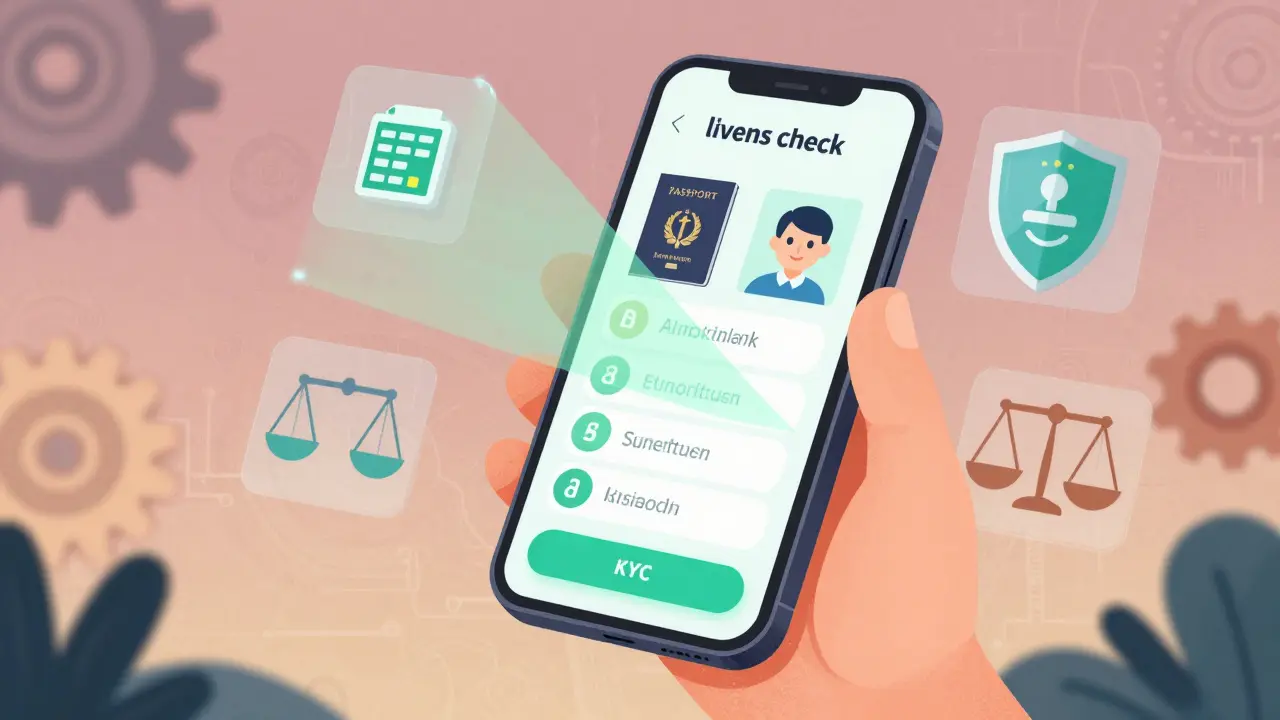
When you submit your information, you are entering a multi-step technical pipeline. It is more sophisticated than just uploading a PDF. Here is what happens behind the scenes:
- Identification: You provide basic personal data: full legal name, date of birth, and residential address.
- Document Verification: You upload a government-issued ID, such as a passport or driver’s license. AI-powered systems analyze these documents for authenticity. Modern tools can detect over 1,200 document types across 200+ countries with high accuracy rates.
- Liveness Check: This is the selfie step. You must prove you are physically present and not using a photo of a person. Advanced systems use 3D depth analysis to prevent spoofing attacks.
- Address Verification: Some platforms require a utility bill or bank statement to confirm your residency.
- Risk Scoring: Algorithms categorize you based on transaction patterns and risk profiles.
For most retail users, this process takes 15 to 25 minutes. However, during peak periods, manual reviews can extend this to 24-72 hours. If you are dealing with higher-risk transactions or amounts exceeding $3,000, exchanges may ask for additional documentation, such as proof of occupation or source of funds.
KYC vs. No-KYC: The Great Divide
The crypto ecosystem is split into two camps: those that comply with regulations and those that do not. Choosing between them depends entirely on your priorities: convenience and security versus privacy and anonymity.
| Feature | KYC-Compliant Exchanges (e.g., Coinbase, Binance) | No-KYC Alternatives (e.g., Uniswap, P2P Networks) |
|---|---|---|
| Identity Requirement | Mandatory ID, selfie, and address proof | None (wallet address only) |
| Fiat On-Ramp | Yes (Bank transfer, credit card) | No (Crypto-to-crypto only usually) |
| Transaction Limits | High ($50,000+ daily after full verification) | Variable (often lower limits or network fees apply) |
| Regulatory Protection | High (Insurance, dispute resolution) | Low to None (Code is law) |
| Privacy Level | Low (Data stored by company) | High (Anonymous wallet interactions) |
| Accessibility | Global (subject to local bans) | Global (but harder to access fiat) |
Centralized exchanges (CEXs) like Coinbase, Kraken, and Binance enforce strict KYC. They offer the benefit of fiat integration-you can easily swap dollars for Bitcoin. According to Chainalysis data, 92% of all cryptocurrency-to-fiat transactions occur on these KYC-compliant platforms. They also offer customer support and account recovery options.
On the other side, Decentralized Exchanges (DEXs) like Uniswap and PancakeSwap operate without KYC. You connect your wallet, and you trade. There is no central entity asking for your name. However, you generally cannot deposit fiat currency directly. You must already hold crypto to trade on these platforms. Additionally, the number of viable no-KYC on-ramps has decreased significantly due to regulatory pressure, making it harder for newcomers to enter the space anonymously.
The Privacy Debate: Security vs. Surveillance
The introduction of KYC has sparked intense debate within the crypto community. Proponents argue that it legitimizes the industry, attracting institutional investors and protecting users from fraud. Critics argue it betrays the core ethos of decentralization and financial privacy.
Dr. David L. Shrier, author of 'Trust Data: A New Framework for Identity and Data Rights,' argues that KYC is necessary but insufficient. He points out that sophisticated money launderers often use layered transactions across multiple platforms to circumvent checks. Meanwhile, Dr. Marion Laboure from Harvard Kennedy School notes that current KYC implementations can create a false sense of security, as illicit funds still move through compliant exchanges via synthetic identities.
From a user perspective, the concerns are real. In a 2023 survey, 68% of crypto users cited personal data protection as their primary reason for seeking no-KYC alternatives. Younger users, particularly those aged 18-24, are significantly more likely to prioritize privacy over convenience. However, the reality is that data breaches happen. When you store your ID and biometric data on an exchange’s server, you are trusting them to protect it. While major exchanges invest heavily in cybersecurity, no system is immune to attacks.

Navigating the Process: Tips for Success
If you decide to use a KYC-compliant platform, you want the process to go smoothly. Rejections are common and frustrating. Here is how to avoid the most frequent pitfalls:
- Lighting Matters: Glare is the number one cause of document rejection. Use natural light and ensure your ID is flat against a dark, non-reflective surface.
- Check Expiration Dates: Many systems automatically reject IDs that are expired or expiring within six months.
- Match Names Exactly: Ensure the name on your ID matches the name you entered during registration. Even small discrepancies like nicknames can cause failures.
- Use the Mobile App: Exchanges like Gemini report that using their mobile app for verification reduces rejection rates by over 60% due to better camera control and lighting adjustments.
- Prepare Address Proof: Have a recent utility bill or bank statement ready. Digital copies are often accepted, but they must be clear and legible.
If your verification is rejected, check your email for specific reasons. Most platforms allow you to resubmit immediately. If you are stuck, customer support quality varies wildly. Major exchanges like Coinbase offer 24/7 chat support with average response times under 10 minutes, while smaller platforms may take days to respond via email.
The Future of KYC in 2026 and Beyond
As we settle into 2026, the trend is clear: KYC requirements are expanding, not contracting. The IRS’s mandatory 1099-DA reporting requirement necessitates comprehensive KYC for all taxable transactions in the U.S., effectively eliminating most remaining no-KYC options for American taxpayers. Similarly, the EU’s MiCA regulations, fully effective since June 2024, mandate rigorous KYC for all crypto service providers operating within the bloc.
However, technology is evolving to address privacy concerns. We are seeing the rise of decentralized identity solutions, such as Microsoft’s ION and the World Wide Web Consortium’s Verifiable Credentials specification. These technologies aim to provide "privacy-preserving KYC," where you can prove you meet certain criteria (like being over 18 or not being on a sanctions list) without revealing your actual name or address. Pilot programs for these systems are underway across Europe, suggesting a future where compliance and privacy are not mutually exclusive.
For now, though, the choice remains binary. Do you want the ease of fiat conversion and regulatory protection, or do you want the freedom of anonymity? Understanding KYC helps you make that choice with your eyes open.
Why do cryptocurrency exchanges require KYC?
Exchanges require Know Your Customer (KYC) verification to comply with anti-money laundering (AML) laws and counter-terrorism financing regulations. Regulatory bodies like the FATF and FinCEN classify crypto exchanges as money service businesses, mandating that they verify user identities to prevent illegal activities. Non-compliance can result in heavy fines or license revocation.
Can I buy Bitcoin without KYC in 2026?
Yes, but it is more difficult. You can use Decentralized Exchanges (DEXs) like Uniswap if you already own cryptocurrency. For buying with fiat currency, options are limited. Some peer-to-peer (P2P) platforms and certain Bitcoin ATMs may allow small transactions without full KYC, but these options are decreasing due to increased regulatory scrutiny.
Is my data safe when I complete KYC?
Major exchanges invest heavily in cybersecurity to protect your data, but no system is 100% immune to breaches. Your sensitive information, including ID photos and biometric data, is stored on their servers. While encryption and secure storage protocols are standard, there is always a residual risk. Using reputable, regulated exchanges minimizes this risk compared to unknown platforms.
How long does KYC verification take?
Automated verification typically takes 15 to 25 minutes. However, if your documents require manual review due to poor image quality or unusual circumstances, it can take 24 to 72 hours. During peak usage times, delays may be longer. Ensuring high-quality photos and clear documents speeds up the process.
What happens if I fail KYC verification?
If you fail KYC, your account will remain unverified, limiting or preventing trading and withdrawals. Common reasons for failure include glare on documents, expired IDs, or mismatched names. You can usually resubmit corrected documents immediately. If issues persist, contact customer support for assistance.

Rebecca Andrews
I'm a blockchain analyst and cryptocurrency content strategist. I publish practical guides on coin fundamentals, exchange mechanics, and curated airdrop opportunities. I also advise startups on tokenomics and risk controls. My goal is to translate complex protocols into clear, actionable insights.
More Articles

Privacy in Decentralized Identity: How Blockchain Protects Your Data
Learn how decentralized identity uses blockchain and zero-knowledge proofs to protect your data. Discover the difference between centralized and self-sovereign identity systems.

What is a 51% Attack on Blockchain: Risks, Real Examples & Prevention
A 51% attack occurs when a group controls over half of a blockchain's mining power, allowing them to reverse transactions and double-spend. Learn how it works, real-world examples like the 2025 Monero attack, and how to protect your crypto.