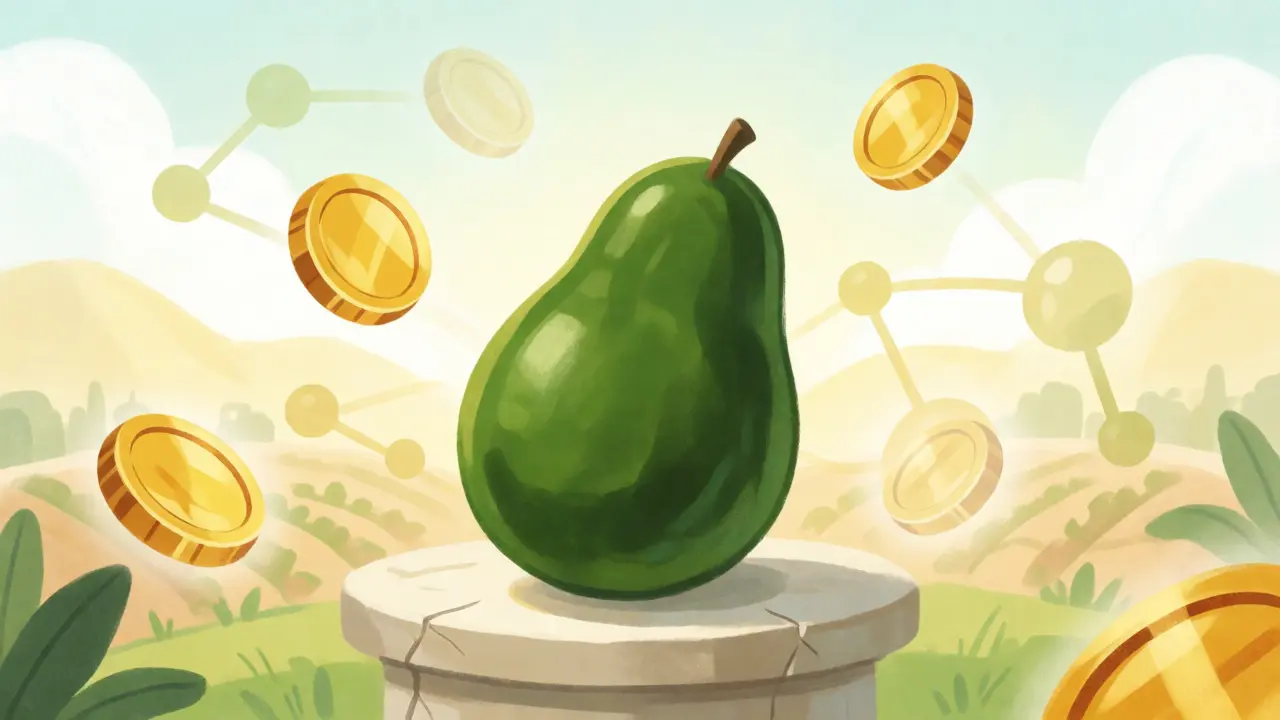
Imagine a cryptocurrency backed by avocado farms that claims its team has been working with blockchain technology for over twenty years. Sounds impressive, right? Except blockchain didn't exist until 2009. This mathematical impossibility is just the tip of the iceberg when you look into AvocadoCoin, also known as AVDO. Launched in mid-2024 by GreenCrypto Corporation OU, this project promised to revolutionize sustainable agriculture through the "GreenGold Project." But if you dig past the glossy marketing materials, you find a landscape riddled with contradictions, missing data, and red flags that scream caution rather than innovation.
If you're here because you saw an ad or heard a buzz about buying AVDO, you need to know what you're actually getting. Is it a legitimate investment in real-world assets, or is it another case of hype outpacing substance? We'll break down the tech, the market data discrepancies, and the community sentiment so you can decide if your money stays in your wallet or gets swept up in the pump.
The Core Promise: Real Assets or Just Buzzwords?
AvocadoCoin is marketed as the first token backed by the avocado industry, specifically targeting sustainable farming in Mexico. The pitch is seductive: buy a digital coin, and you own a slice of productive agricultural land. It’s supposed to bridge the gap between traditional commodities and modern crypto efficiency. However, the execution tells a different story.
The project claims to run on "Smart Blockchain 4.0," a term that doesn't appear in any recognized technical standards documentation. When you check blockchain explorers like Solscan or Etherscan, the narrative shifts again. Data from CoinLore suggests AVDO functions as a token on the Solana blockchain, while other sources remain vague. Why does this matter? Because Solana is fast and cheap, but it requires specific technical integration. If the developers can't even agree on which chain hosts their primary asset, how can we trust them to manage complex smart contracts for land ownership?
Furthermore, the claim of backing by "real-world assets" lacks transparency. Compare this to Paxos Gold (PAXG), where every token is audited monthly against physical gold reserves held in vaults. With AVDO, there are no published audits proving that the claimed Mexican farmland actually exists or is owned by the entity issuing the tokens. In fact, Mexican law (Article 27 of the Constitution) restricts foreign entities from directly owning certain types of agricultural land near borders and coasts, adding a layer of legal complexity that the whitepaper-when it was available-failed to address clearly.
Market Data: A House of Cards
If you try to look up AVDO's price today, you might get three different numbers depending on which site you visit. This isn't normal volatility; it's a sign of fragmented liquidity and potentially manipulated reporting.
| Metric | Coinbase Listing | CoinLore Report | LiveCoinWatch |
|---|---|---|---|
| Price Estimate | $1,451.54 | $1,553.00 | $1,602.46 |
| 24h Trading Volume | $247,692.87 | Data Varies | $495,040.00 |
| Market Cap Claim | $0 (Circulating Supply 0) | $21.9 Billion | N/A |
| Total Supply | 21,000,000 | 21,000,000 | 21,000,000 |
Look closely at that market cap column. CoinLore reports a $21.9 billion valuation. To put that in perspective, that would make AvocadoCoin one of the top 11 cryptocurrencies in the world, rivaling giants like Cardano or Avalanche. Yet, on the same platform, it ranks around #4939. How can a token be both a global leader and a minor player simultaneously? Coinbase lists the circulating supply as zero, implying no coins are actually trading freely despite active volume figures. These inconsistencies suggest either extreme incompetence in data reporting or deliberate manipulation to inflate perceived value.

The "Two Decades" Lie
One of the most glaring issues with AvocadoCoin is its origin story. Press releases state that the team behind GreenCrypto Corporation OU has been "at the forefront of merging blockchain technology with the Internet of Things (IoT) for over two decades." Let's do the math. Bitcoin, the first successful implementation of blockchain, launched in January 2009. Twenty years prior to 2024 is 2004. What exactly were they doing with blockchain in 2004?
This isn't just a typo. It's a fundamental credibility killer. As Dr. Elena Rodriguez from MIT's Digital Currency Initiative noted, claiming experience before the technology existed raises immediate red flags. It suggests the marketing copy was written by someone who didn't understand the subject matter, or worse, was designed to confuse non-expert investors. When a project fails basic historical fact-checking, it casts doubt on every other claim they make, including the existence of their "GreenGold Project" infrastructure.
Community Sentiment and User Experience
Money talks, but users shout louder. The feedback loop for AVDO has been overwhelmingly negative since its June 2024 launch. On Reddit’s r/CryptoCurrency, threads discussing AVDO often devolve into warnings about "agricultural buzzword scams." One verified user, claiming to be an avocado farmer in Michoacán, Mexico-the region supposedly central to the project-stated he had never heard of GreenCrypto Corporation contacting local growers. If the supply chain partners don't know about the product, how is the product real?
Technical support is another pain point. Users report withdrawal issues with resolution times exceeding two weeks. For a crypto asset, speed is usually a selling point. Waiting fourteen days to access your funds defeats the purpose of using a high-speed blockchain like Solana. Moreover, the official Telegram community shrank from over 2,000 members at launch to roughly 1,200 within weeks. People joined hoping for gains; they left realizing the exit doors were locked.
- Trustpilot Rating: 1.2/5 stars based on 12 reviews.
- Common Complaints: Impossible claims, withdrawal delays, lack of whitepaper.
- Social Media Activity: HypeAuditor analysis flagged 87% of Twitter engagement as bot-like.
How to Buy (and Should You?)
If you still want to test the waters, buying AVDO isn't straightforward. It isn't listed on major centralized exchanges like Binance Spot or Coinbase Prime. Instead, you typically need to use a Web3 wallet connected to decentralized exchanges (DEXs). This adds friction. You have to navigate slippage, gas fees, and potential rug-pull risks inherent to low-cap DEX listings.
Before you click "swap," ask yourself these questions:
- Can I find a verifiable audit of the underlying assets?
- Does the project have a public GitHub repository with code commits?
- Is the team doxxed (publicly identified) with verifiable LinkedIn profiles?
As of late 2024, the answer to all three is largely "no." There are no official GitHub repositories linked to the main website. The team remains somewhat anonymous or poorly documented. Without code transparency, you are trusting a black box with your capital.
The Verdict: High Risk, Low Reward Potential
AvocadoCoin occupies a precarious niche. While the intersection of agriculture and blockchain is a valid sector-dominated by serious players like IBM Food Trust and Ripe.io-AVDO appears to be riding the wave without building a surfboard. The combination of impossible historical claims, contradictory market data, and poor user experience places it in the highest risk category for new tokens.
Investors should treat AVDO not as an investment in avocado futures, but as a speculative gamble on marketing momentum. Given the declining trading volume and shrinking community, the likelihood of long-term sustainability seems slim. If you are looking for exposure to agri-tech, established platforms with proven traceability systems offer safer entry points.
Is AvocadoCoin a legitimate cryptocurrency?
Legitimacy is subjective, but AVDO exhibits many traits of a questionable project. Key red flags include claiming blockchain experience prior to 2009, inconsistent market data across trackers, and a lack of verifiable proof for its claimed agricultural asset backing. Most independent analysts classify it as high-risk.
Which blockchain does AvocadoCoin use?
Data is conflicting. Some sources indicate it is a token on the Solana blockchain, while the project's own website references "Smart Blockchain 4.0," which is not a standard technical term. This ambiguity makes technical verification difficult.
Why is the market cap of AVDO so confusing?
Different data aggregators calculate market cap differently. CoinLore reported a $21.9 billion cap, which contradicts its own ranking (#4939) and the actual trading volume. Coinbase listed circulating supply as zero. These discrepancies suggest either calculation errors or inflated metrics to attract buyers.
Can I buy AvocadoCoin on Binance?
Not on the main centralized exchange. You generally need to use Binance's Web3 Wallet to connect to decentralized exchanges (DEXs) where AVDO is traded. This involves higher technical barriers and potential security risks compared to standard spot trading.
What is the "GreenGold Project"?
It is the initiative promoted by AvocadoCoin to link token value to sustainable avocado farming in Mexico. However, there is little public evidence or third-party verification confirming that the project has successfully acquired or managed significant agricultural land assets.

Rebecca Andrews
I'm a blockchain analyst and cryptocurrency content strategist. I publish practical guides on coin fundamentals, exchange mechanics, and curated airdrop opportunities. I also advise startups on tokenomics and risk controls. My goal is to translate complex protocols into clear, actionable insights.
More Articles

MFSA Crypto Rules Explained: Malta's New MiCA Regulations for 2026
Explore the new MFSA crypto rules in Malta for 2026. Learn how the MiCA regulation replaced the VFA Act, who needs a license, and how to navigate the authorization process.