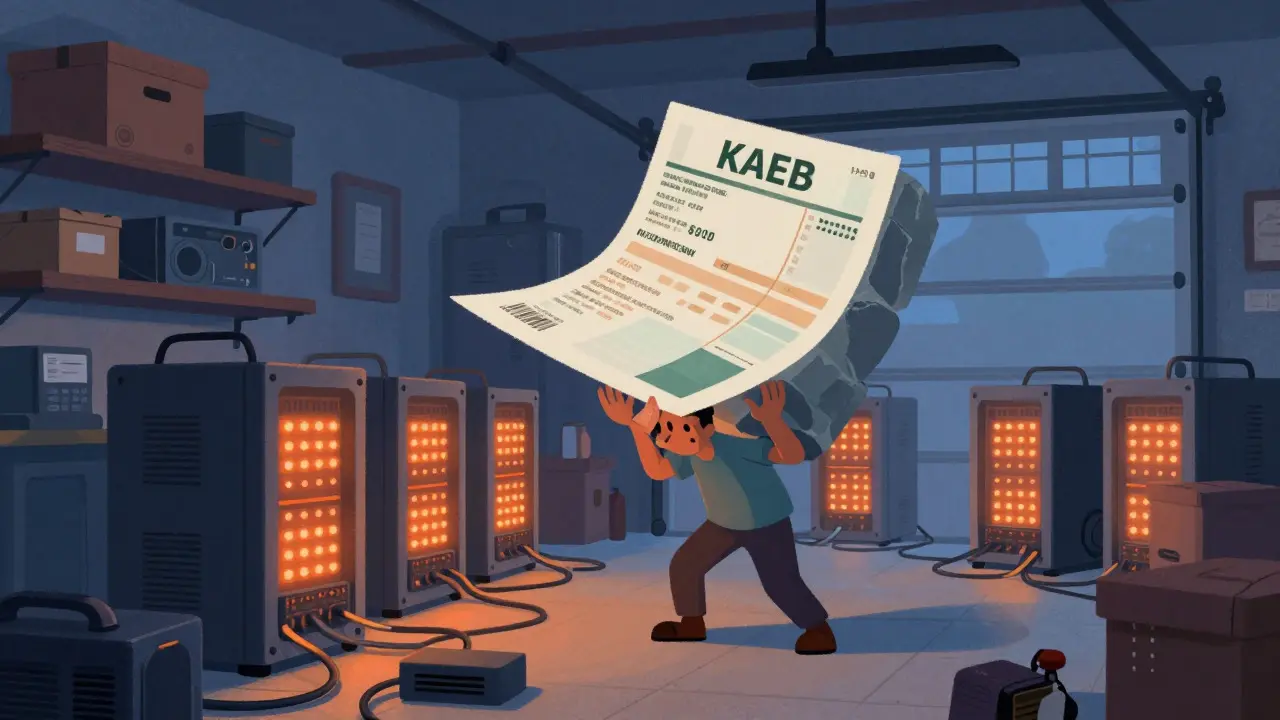
Imagine setting up a rig in your garage, only to realize that the electricity bill is just the beginning of your financial headache. In India, crypto mining isn't banned, but it’s certainly not easy. You’re navigating a maze of taxes, anti-money laundering checks, and regulatory uncertainty that can turn a profitable venture into a legal nightmare if you aren’t careful.
The core problem? There is no specific "Crypto Mining Act" in India. Instead, miners fall under the broader Virtual Digital Asset (VDA) framework introduced in 2022 and updated through 2025. This means your mined coins are treated like any other digital asset for tax purposes, but with a heavy penalty attached. If you’re thinking about starting or continuing mining operations in India, you need to understand exactly where the lines are drawn between legal compliance and potential trouble.
The Legal Gray Area: Is Mining Actually Illegal?
Short answer: No, it’s not illegal. But calling it "legal" without context is misleading. The Supreme Court of India’s 2020 decision in Internet and Mobile Association of India v Reserve Bank of India set aside the RBI’s blanket ban on crypto, but it also affirmed the government’s right to legislate against cryptocurrencies at any time. This creates a permanent state of unease for miners. Today, over 107 million Indians engage with crypto assets, yet specific guidelines for mining remain absent.
Currently, mined cryptocurrencies are classified as Virtual Digital Assets under Section 2(47A) of the Income Tax Act, 1961. This definition covers any code, number, token, or information created through cryptography, explicitly excluding fiat currencies. Because there’s no dedicated mining legislation, your operation is subject to general VDA rules, which were designed more for traders than industrial-scale miners. This gap leaves many questions unanswered, particularly regarding equipment imports and large-scale commercial ventures.
The Tax Burden: Why India Is Expensive for Miners
This is where most miners get caught off guard. India imposes a flat 30% tax rate on all income derived from VDAs, plus an additional 4% cess. That’s a combined 31.2% hit before you even consider other costs. To put this in perspective, many major crypto-friendly jurisdictions allow deductions for operational expenses. In India, you generally cannot deduct electricity bills, pool fees, or maintenance costs from your taxable income. You can only offset the cost of acquisition, which for miners often means very little.
On top of that, a 1% Tax Deducted at Source (TDS) applies to crypto transactions. When you sell your mined coins on an exchange, they withhold this amount. Then, since July 2025, major exchanges like Bybit have imposed an 18% GST on crypto-related services. For a miner converting assets to fiat, this adds another layer of friction. The effective tax burden for mining operations in India can easily exceed 49% when you combine direct taxes, TDS, and GST. This makes small-scale individual mining economically unviable for many, pushing serious operators toward offshore locations or underground setups.

Regulatory Oversight: Who Is Watching You?
You’re not just dealing with one agency; you’re facing a multi-agency watchtower. Here’s who needs to know about your mining activity:
- Income Tax Department (CBDT): They enforce tax compliance. Since the Income Tax (No. 2) Bill, 2025 received presidential assent, the scope of VDAs has expanded to include NFTs and undisclosed income, keeping the 30% rate intact. They use AI-powered systems like Project Insight and NUDGE to track your transactions automatically.
- FIU-IND: The Financial Intelligence Unit ensures anti-money laundering compliance under the Prevention of Money Laundering Act (PMLA) 2002. Recently, FIU-IND issued notices to 25 offshore exchanges for non-compliance, signaling aggressive enforcement. Binance was fined INR 18.82 crore (approx. USD 2.17 million) and Bybit INR 9.27 crore (approx. USD 1.07 million) for PMLA violations. While both are now registered, the message is clear: compliance is being enforced.
- RBI and SEBI: The Reserve Bank of India has been cautious since 2013, issuing public cautions about risks. SEBI began monitoring crypto tokens that resemble securities from April 1, 2025. If your mining involves tokens that look like investment contracts, SEBI might take interest.
Compliance Checklist for Indian Miners
To stay out of trouble, you need to treat your mining operation like a formal business entity, even if it’s just you and a few machines. Here is what you must do:
- Declare Everything: Report all mining activities under Schedule VDA in your Income Tax Return. Include dates of rewards, asset names, values, and TDS paid.
- Maintain Detailed Records: Keep receipts for mining equipment purchases, electricity bills, pool fees, and every single unit of cryptocurrency mined. Even though you can’t deduct these costs, auditors will want to see them to verify your income sources.
- Track TDS Payments: Ensure your exchanges are correctly withholding the 1% TDS and that you’re claiming it as a credit in your return.
- Monitor Exchange Compliance: Only use exchanges that are FIU-IND registered. Using unregistered platforms increases your risk of being flagged for money laundering.

Future Outlook: What’s Coming Next?
The regulatory landscape is still shifting. The government released a discussion paper in June 2025 seeking public consultation on a comprehensive framework. A multi-agency model involving the RBI, SEBI, and Finance Ministry is being proposed, which could lead to sector-specific rules for mining in the future.
More significantly, India plans to adopt the OECD Crypto-Asset Reporting Framework (CARF) by April 2027. This will bring offshore mining pools and international activities by Indian residents under strict reporting requirements. If you’re running rigs abroad, don’t think you’re safe-cross-border cooperation on tax enforcement is coming. Meanwhile, the FSB peer review preparation in May 2025 aims to align local regulation with global standards, suggesting further tightening rather than relaxation.
| Aspect | Current Status (2026) | Impact on Miners |
|---|---|---|
| Legal Status | Not prohibited, but no specific mining law | High uncertainty; reliance on general VDA rules |
| Tax Rate | 30% flat + 4% cess | One of the highest globally; no expense deductions |
| TDS | 1% on transactions | Withheld at source by exchanges |
| GST | 18% on platform services | Additional cost on conversion/transactions |
| AML Oversight | FIU-IND under PMLA 2002 | Strict record-keeping; fines for non-compliance |
| Future Framework | OECD CARF adoption planned by 2027 | Offshore mining activities will be reportable |
Practical Advice for Staying Compliant
If you’re determined to mine in India, focus on transparency. The government uses AI tools to cross-reference bank transfers, exchange data, and utility bills. Discrepancies trigger automated notices. Penalties for tax non-compliance range from 50% to 200% of the tax due, with possible imprisonment up to 7 years for serious evasion.
Consider whether the economics work for you. With electricity costs varying by state and the inability to deduct operational expenses, calculate your break-even point carefully. Many miners find that moving to regions with cheaper renewable energy or operating through compliant corporate structures offers better protection and efficiency. Always consult with a tax professional who specializes in VDAs, as the rules are complex and frequently updated.
Is crypto mining banned in India?
No, crypto mining is not banned. However, it falls under the Virtual Digital Asset (VDA) regulations, which impose high taxes and strict compliance requirements. There is no specific law governing mining, creating a regulatory gray area.
What is the tax rate on mined cryptocurrency in India?
The tax rate is 30% on the value of mined assets, plus a 4% cess. Additionally, a 1% TDS applies to transactions, and an 18% GST may apply to exchange services. Unlike other countries, you generally cannot deduct operational costs like electricity from your taxable income.
Which agencies regulate crypto mining in India?
The Income Tax Department handles taxation, while FIU-IND enforces anti-money laundering laws under the PMLA. The RBI and SEBI also play roles in monitoring risks and securities-like tokens, respectively.
Can I deduct electricity costs from my mining income?
Generally, no. Under current VDA rules, only the cost of acquisition is deductible. Operational expenses like electricity, maintenance, and pool fees cannot be offset against mining income, making the effective tax burden much higher.
What happens if I mine offshore?
If you are an Indian resident, your global income is taxable. With the planned adoption of the OECD CARF framework by 2027, offshore mining activities will face stricter reporting requirements and cross-border tax enforcement.

Rebecca Andrews
I'm a blockchain analyst and cryptocurrency content strategist. I publish practical guides on coin fundamentals, exchange mechanics, and curated airdrop opportunities. I also advise startups on tokenomics and risk controls. My goal is to translate complex protocols into clear, actionable insights.
More Articles

Understanding DeFi Protocols and Applications in 2025
DeFi protocols let you lend, borrow, and trade crypto without banks. In 2025, $156 billion is locked in systems like Uniswap, Aave, and MakerDAO. Learn how they work, their risks, and who they're for.