
Imagine selling your Bitcoin for a profit of ₹1,00,000. In many countries, you might pay 10% or even 20% in taxes. But if you are an Indian resident, the government takes ₹30,000 right off the top. And here is the kicker: if you lost ₹90,000 on Ethereum trades that same month, it doesn't matter. You still owe that full ₹30,000. This isn't a hypothetical nightmare scenario; it is the reality of India's 30% cryptocurrency tax, which has created one of the most complex and expensive environments for digital asset traders in the world.
Since Finance Minister Nirmala Sitharaman introduced this framework in the April 2022 Union Budget, the rules have only tightened. With the addition of Goods and Services Tax (GST) on exchange fees in July 2025, the cost of doing business with crypto in India has skyrocketed. If you are holding Bitcoin, Ethereum, or any other Virtual Digital Asset (VDA), understanding these rules isn't just good practice-it is essential to avoid heavy penalties from the Income Tax Department.
How the 30% Flat Rate Actually Works
The core of this taxation regime sits under Section 115BBH of the Income Tax Act. It imposes a flat 30% tax on all gains derived from the transfer of VDAs. What makes this unique-and difficult-is that there is no distinction between short-term and long-term capital gains. Whether you held your Bitcoin for two weeks or ten years, the tax rate remains exactly the same.
Here is how the calculation breaks down in real life:
- Base Tax: 30% of your net profit.
- Cess: An additional 4% health and education cess applies to the base tax.
- Effective Rate: For most individual investors without surcharges, the final effective tax rate is 31.2%.
Let’s look at a concrete example. You buy 0.1 Bitcoin for ₹5,00,000. Later, you sell it for ₹8,00,000. Your profit is ₹3,00,000. The tax liability is calculated as follows:
- Calculate Profit: ₹8,00,000 - ₹5,00,000 = ₹3,00,000.
- Apply 30% Tax: ₹3,00,000 × 0.30 = ₹90,000.
- Apply 4% Cess: ₹90,000 × 0.04 = ₹3,600.
- Total Tax Due: ₹93,600.
This structure eliminates the traditional benefits of long-term investing. In equity markets, holding assets longer often reduces your tax burden. In India's crypto market, time in the market does not equal tax savings.
The Trap of No Loss Offsetting
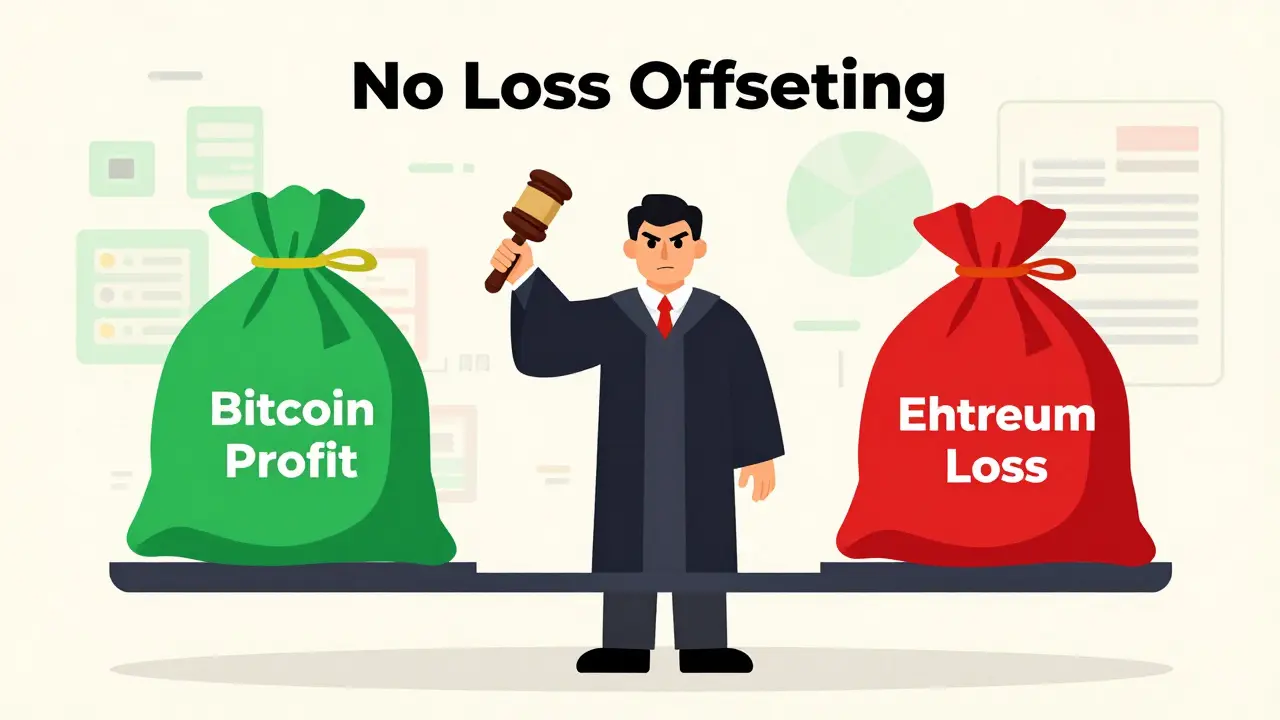
If the high tax rate wasn't enough, the prohibition on loss offsetting is what keeps many traders up at night. Under standard income tax laws, if you lose money in one investment, you can usually set that loss against profits in another to lower your overall taxable income. Crypto loss offsetting is strictly banned in India.
You cannot set off losses from one cryptocurrency against gains from another. Furthermore, you cannot carry forward these losses to future financial years. This means every single profitable transaction is taxed in isolation, regardless of your portfolio's overall performance.
| Asset | Purchase Price | Selling Price | Profit/Loss | Taxable Amount | Tax Liability (31.2%) |
|---|---|---|---|---|---|
| Bitcoin | ₹10,00,000 | ₹12,00,000 | +₹2,00,000 | ₹2,00,000 | ₹62,400 |
| Ethereum | ₹5,00,000 | ₹3,00,000 | -₹2,00,000 | ₹0 (Loss ignored) | ₹0 |
| Total Portfolio | ₹15,00,000 | ₹15,00,000 | ₹0 Net Gain | ₹2,00,000 | ₹62,400 |
In the table above, notice that despite breaking even on your total portfolio value, you still owe ₹62,400 in taxes. This rule disproportionately affects active traders who frequently move in and out of different altcoins, creating a mix of winners and losers.
Understanding TDS and the New GST Layer
Taxes aren't the only deduction you need to worry about. Since July 2022, Section 194S mandates a 1% Tax Deducted at Source (TDS) on crypto transfers exceeding ₹50,000 in a financial year. This amount is deducted by the exchange or the buyer before you receive your funds. While this TDS can be claimed back when filing your returns, it ties up your capital and requires meticulous tracking to ensure you don't overpay during the year.
Then came the July 2025 update: the application of 18% GST on crypto platform services. This means that trading fees charged by exchanges are now subject to Goods and Services Tax. If an exchange charges a 0.1% trading fee, you are effectively paying 0.118%. Over hundreds of trades, this adds significant friction costs to your strategy.
The combination of 30% income tax, 1% TDS, and 18% GST on fees creates a three-tier compliance web. Many users report confusion regarding whether GST applies to Peer-to-Peer (P2P) transactions or only centralized exchange fees. Currently, official guidance suggests GST applies to services provided by registered entities, meaning direct wallet-to-wallet transfers may escape GST, but they remain fully liable for income tax and potential TDS obligations depending on the counterparty.
Record Keeping: The Key to Survival
Because losses cannot be offset, your primary defense is accurate record-keeping. You must prove your cost basis for every single asset. The Income Tax Department requires detailed reporting via Schedule VDA in your income tax return.
What do you need to track?
- Date of Acquisition: When you bought the asset.
- Purchase Price: The exact INR value at the time of purchase.
- Date of Transfer: When you sold or swapped the asset.
- Sale Price: The INR value received.
- Wallet Addresses: To link transactions to specific accounts.
For simple buy-and-hold investors, this might take 10-15 hours a year. For active traders using multiple exchanges, DeFi protocols, and NFT marketplaces, this can easily consume 40-50 hours annually. Many professionals recommend using specialized crypto tax software like Koinly or ClearTax, which have updated their modules to handle India's specific Schedule VDA requirements through 2025. These tools automate the calculation of gains and losses, reducing the risk of human error in a system where mistakes are costly.

Global Comparison: How Does India Stack Up?
To understand the weight of these regulations, it helps to look abroad. India's approach is notably stricter than many major economies.
| Country | Tax Treatment | Long-Term Benefit | Loss Offsetting |
|---|---|---|---|
| India | Flat 30% + Cess | None | No |
| United States | Capital Gains (0-20%) | Lower rates after 1 year | Yes |
| Germany | Income Tax Rate | Tax-free after 1 year | Yes |
| Singapore | No Capital Gains Tax | N/A | N/A |
| United Kingdom | 10-20% Capital Gains | Annual Exempt Amount | Yes |
In Germany, for instance, holding crypto for more than one year makes your gains completely tax-free. In the US, long-term holdings benefit from reduced capital gains rates. India offers neither comfort nor flexibility. This disparity has led to a migration of trading volume to international platforms, although users must remain vigilant about their residency-based tax obligations regardless of where they trade.
Strategies for Navigating the Framework
While you cannot change the law, you can adapt your behavior. Here are practical steps to manage your exposure:
- Avoid Frequent Swapping: Every swap is a taxable event. Moving from Bitcoin to Ethereum triggers a sale of Bitcoin. Minimize unnecessary conversions to reduce the number of taxable events.
- Use FIFO Method Carefully: First-In, First-Out is the standard accounting method. Ensure your records reflect this accurately to calculate the correct cost basis.
- Claim TDS Credits: Don't forget the 1% TDS deducted by exchanges. Use Form 26AS to verify these deductions and claim them as credits when filing your return to avoid double taxation.
- Consult a CA Specializing in Crypto: Given the complexity of Schedule VDA and the lack of loss offsetting, professional advice can save you thousands in potential errors or missed optimizations within the allowable legal framework.
The regulatory landscape is still evolving. With the Reserve Bank of India and SEBI expected to introduce further digital asset regulations, staying informed is crucial. The current punitive structure aims to curb speculation, but it also demands rigorous compliance from those who choose to participate in the market.
Can I offset my crypto losses against stock market gains in India?
No. Under Section 115BBH, losses from Virtual Digital Assets cannot be set off against any other income, including salary, business income, or capital gains from stocks and mutual funds. Crypto losses are siloed and cannot be carried forward either.
Is the 30% tax rate applied to the total value of my crypto holdings?
No. The 30% tax is applied only to the gains (profit) made from the transfer or sale of the asset. If you hold Bitcoin but do not sell it, you do not pay capital gains tax. However, if you gift it or use it to pay for goods, it is considered a transfer and may trigger tax liability based on the fair market value at that time.
Does the 1% TDS apply to P2P transactions?
Technically, yes, if the buyer is responsible for deducting TDS under Section 194S. However, in informal P2P deals, enforcement is challenging. The seller is still liable for the 30% income tax on the gain. Relying on P2P to avoid TDS carries compliance risks if the transaction is reported by the bank or exchange facilitating the fiat transfer.
What counts as a Virtual Digital Asset (VDA)?
Under Section 2(47A), VDAs include cryptocurrencies like Bitcoin and Ethereum, Non-Fungible Tokens (NFTs), and other digital tokens. It explicitly excludes gift cards, vouchers, and loyalty points that are redeemable only for goods or services within a specific ecosystem.
Do I need to file a tax return if I only hold crypto and never sell?
If you have not transferred (sold/swapped/gifted) any VDAs and have no other taxable income, you generally do not need to report holdings in Schedule VDA. However, if you own crypto worth significant amounts, some advisors recommend filing voluntarily to establish a clear audit trail of your acquisition dates and costs, though this is not legally mandatory unless a taxable event occurs.

Rebecca Andrews
I'm a blockchain analyst and cryptocurrency content strategist. I publish practical guides on coin fundamentals, exchange mechanics, and curated airdrop opportunities. I also advise startups on tokenomics and risk controls. My goal is to translate complex protocols into clear, actionable insights.
More Articles

Nonce Range and Mining Difficulty: How Bitcoin Secures the Network
Discover how the nonce range and mining difficulty work together to secure Bitcoin. Learn why solo mining is tough today and how difficulty adjusts every two weeks.

IMOEX Crypto Exchange Review: Is This Platform Legitimate in 2026?
IMOEX is not a legitimate crypto exchange. No reviews, no regulation, no presence on any trusted platform. This is a scam. Learn how fake exchanges operate and where to trade safely in 2026.

What is Ju Token (JU) Crypto Coin? Full Breakdown of Its Tech, Tokenomics, and Real-World Use
Ju Token (JU) is the native coin of JuChain, a Layer 1 blockchain built to turn user engagement into rewards. With a unique traffic finance model, fixed supply, and daily emissions, JU rewards users for using dApps - not just holding tokens.