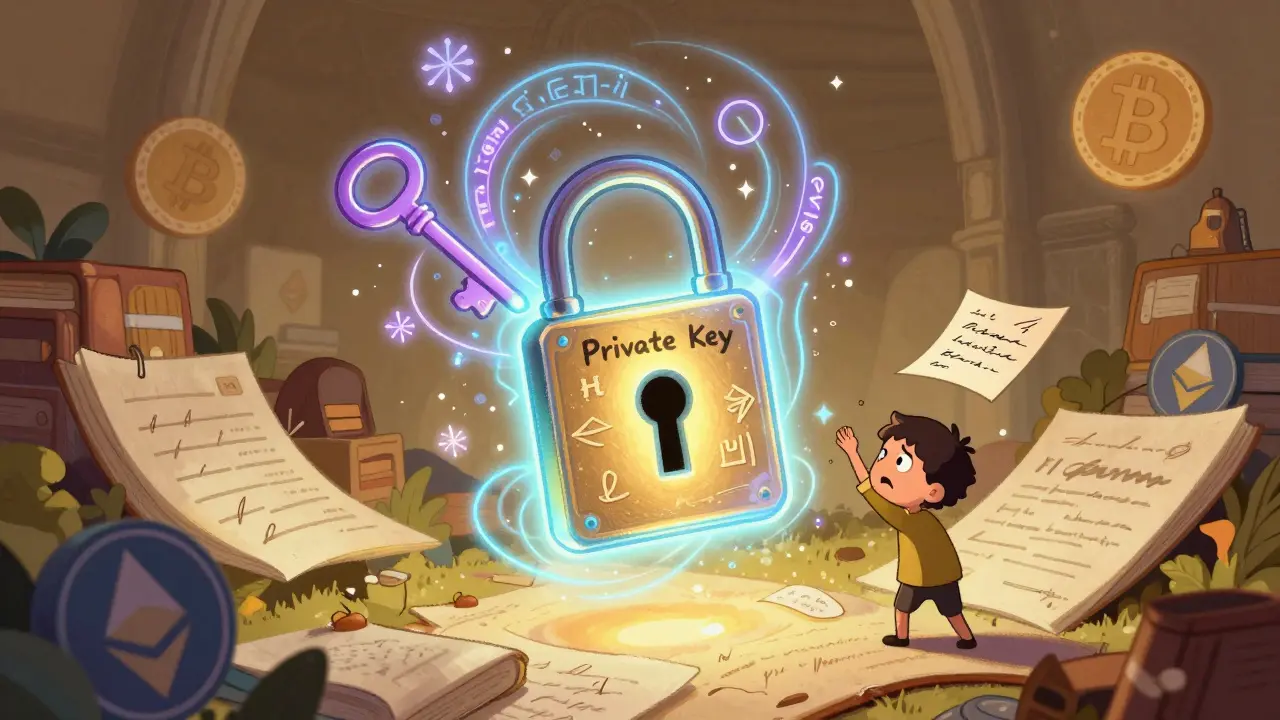
When you send Bitcoin or Ethereum, you don’t sign a piece of paper. You don’t scribble your name at the bottom of a receipt. Instead, you use a digital signature-a math-based proof that only you can create, and anyone can verify. This isn’t just a fancy upgrade. It’s the reason blockchain works at all. Without it, crypto would be as secure as a postcard left on a park bench.
How Digital Signatures Actually Work
A digital signature isn’t a scanned image of your handwriting. It’s a string of numbers generated by your private key. That key is a secret number, stored securely on your device or hardware wallet. When you sign a transaction, your wallet takes the details-like who you’re sending money to and how much-and runs them through a cryptographic algorithm. The result? A unique signature tied to that exact transaction. The most common algorithm used in Bitcoin and Ethereum is ECDSA-Elliptic Curve Digital Signature Algorithm. It’s fast, secure, and uses short keys. A 256-bit ECDSA key gives you the same security as a 3,072-bit RSA key, but it’s way smaller and faster to process. That matters when you’re handling millions of transactions a day. Verification is just as simple. Anyone on the network can take your public key (which is shared openly) and check if the signature matches the transaction data. If even one bit changes-say, someone tries to alter the recipient’s address-the signature becomes invalid. No guesswork. No debate. Just math.What Traditional Signatures Can’t Do
A handwritten signature is a pattern of lines, pressure, and speed. It’s unique to you-but so is your fingerprint. And just like fingerprints can be lifted, signatures can be forged. Skilled forgers replicate styles. People sign documents without reading them. Banks still rely on clerks to compare signatures on checks, often with no real training. In crypto, that kind of subjectivity is a disaster. Imagine if someone could claim, “I didn’t sign that transaction,” just because their handwriting looked different that day. There’d be no way to prove otherwise. Digital signatures eliminate that. The signature is either valid or it isn’t. No opinions. No lawyers needed. Plus, traditional signatures don’t tie to content. You can sign a blank sheet of paper, then add text later. In crypto, the signature is mathematically locked to the exact transaction data. Change the amount? The signature breaks. Change the recipient? The signature breaks. It’s tamper-proof by design.Why Digital Signatures Are the Only Choice for Blockchain
Blockchain doesn’t have a central authority. No bank, no notary, no judge. So how do you know who sent what? Digital signatures solve that. They’re the only way to prove ownership without revealing your private key. Think about multi-signature wallets. You need three people to approve a large transfer. With traditional signatures, that means three wet signatures on paper-slow, messy, easy to lose. With digital signatures, each person signs digitally. The network checks all three at once. No mail. No waiting. Done in seconds. Even better: Schnorr signatures. Introduced in Bitcoin’s Taproot upgrade in 2021, they let multiple signatures combine into one. So a 5-of-10 multisig looks like a regular single-signature transaction. That saves space, lowers fees, and improves privacy. No one can tell if a transaction needed five people to sign-or just one. BLS signatures, used in Ethereum 2.0, take this further. They can aggregate thousands of signatures into a single one for an entire block. That means less data on the chain, faster syncing, and lower costs. Traditional signatures can’t do anything like that.
Security: Math vs. Muscle
A forged handwritten signature might fool a human. But it won’t fool a computer running cryptographic verification. Digital signatures rely on problems that are easy to compute one way but nearly impossible to reverse. ECDSA uses elliptic curve math. To crack it, you’d need to solve the discrete logarithm problem for a curve with 256 bits of security. Even the world’s fastest supercomputers would take billions of years. That’s not theoretical. It’s proven. Traditional signatures? A good forger with access to your signature samples can replicate it well enough to pass a bank’s manual check. Studies show up to 30% of signature fraud goes undetected in financial institutions. In crypto, that number is zero-if you keep your private key safe. Non-repudiation is another win. If you sign a crypto transaction, you can’t later say, “I didn’t mean to send that.” The blockchain has a permanent, cryptographically verified record. Courts in the U.S., EU, and elsewhere recognize digital signatures as legally binding under laws like ESIGN and eIDAS. Handwritten signatures? You can claim you were pressured, drunk, or tricked. Digital? Not so easy.Scalability and Automation
A bank employee might spend 30 seconds verifying one signature. A computer can verify 10,000 digital signatures in under a second. That’s why exchanges process millions of trades daily. No human could keep up. Smart contracts rely entirely on digital signatures. When a DeFi protocol releases funds only if two parties sign, it checks the signatures automatically. No middlemen. No delays. No errors. Traditional signatures? You’d need a human to review each one. That’s not scalable. It’s not even practical. And automation doesn’t just save time-it reduces risk. Humans make mistakes. Computers don’t. A digital signature either matches or it doesn’t. There’s no interpretation. No bias. No fatigue.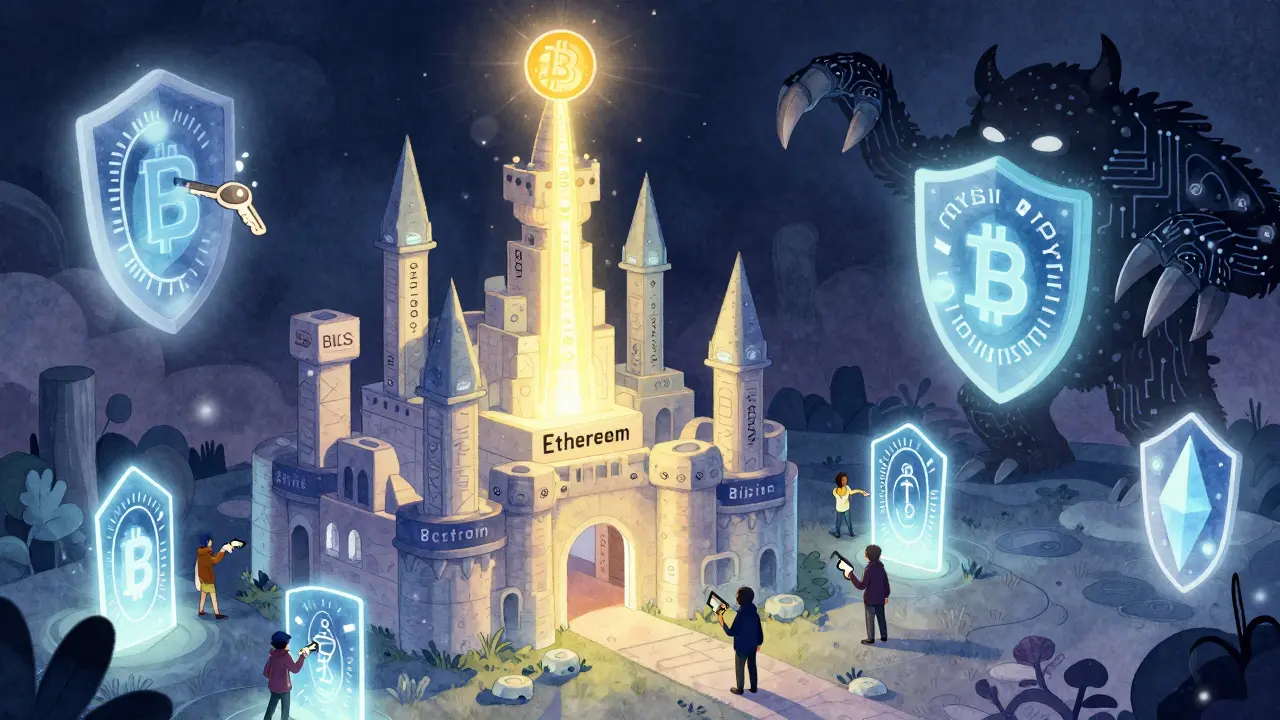
What’s Next? Post-Quantum Signatures
Today’s digital signatures are secure-but not forever. Quantum computers, still in early development, could eventually break ECDSA and RSA by solving the math problems they rely on. That’s why researchers are already building replacements. Algorithms like CRYSTALS-Dilithium and Falcon are being tested for use in blockchain. These are designed to resist quantum attacks. Ethereum and Bitcoin aren’t switching tomorrow, but the work is underway. The first quantum-resistant blockchains are expected to launch by 2028. Meanwhile, digital identity projects like Microsoft’s ION and Hyperledger Indy are combining digital signatures with decentralized identifiers. Soon, you might sign a crypto transaction not just with a key, but with a verifiable digital identity tied to your real-world credentials-without revealing them.Final Reality Check
Traditional signatures have their place-paper contracts, notarized deeds, legal filings. But in crypto? They’re obsolete. There’s no middle ground. You can’t mix a pen signature with a blockchain transaction. It doesn’t compute. The real question isn’t whether digital signatures are better. It’s why anyone would still consider using anything else. They’re faster. They’re safer. They’re automated. They’re verifiable by anyone, anywhere, without trust. If you’re holding crypto, you’re already using digital signatures. The only thing left to learn is how to protect your private key. Because once that’s gone, no signature-digital or otherwise-can bring it back.Can a digital signature be forged like a handwritten one?
No, not in the way people forge handwritten signatures. You can’t copy a digital signature by tracing or mimicking it. It’s created using a private key that only the owner has. To fake it, you’d need to crack the cryptographic math behind it-like solving an unsolvable puzzle with today’s technology. Even if someone stole your device, they’d still need your password or biometric to access the key. Without it, forging a signature is computationally impossible.
Do I need a certificate authority to use a digital signature in crypto?
Not for basic crypto transactions. Unlike email or corporate systems that use PKI and certificates from trusted authorities, Bitcoin and Ethereum use public key cryptography directly. Your public key is your address. Your private key is your signature. No middleman needed. Certificate authorities are used in enterprise digital signatures, but they’re irrelevant in most blockchain use cases.
Why does Bitcoin use ECDSA instead of RSA?
ECDSA uses much smaller keys than RSA for the same level of security. A 256-bit ECDSA key equals a 3,072-bit RSA key in strength. Smaller keys mean faster transaction processing, less storage space on the blockchain, and lower fees. Since Bitcoin handles millions of transactions, efficiency matters. RSA would slow everything down and bloat the chain.
Can I use the same digital signature for multiple transactions?
No. Each digital signature is tied to the exact data it signs. Even if you send the same amount to the same person twice, each transaction has different details-like timestamps, nonces, or input references. That means each one generates a unique signature. Reusing a signature would be a major security flaw and is blocked by the network.
What happens if I lose my private key?
You lose access to your funds permanently. There’s no reset button, no customer service line, no recovery option. Digital signatures rely on the private key being secret and only in your control. If it’s gone, the signature can’t be recreated. That’s why backups-like seed phrases-are so critical. Treat them like a master key to your life savings.
Are digital signatures legally valid in crypto transactions?
Yes. Laws like the U.S. ESIGN Act and the EU’s eIDAS regulation recognize digital signatures as legally binding if they meet certain criteria-like being uniquely linked to the signer and capable of detecting tampering. In crypto, since every signature is cryptographically tied to a specific transaction and can’t be repudiated, courts have upheld them as valid proof of authorization.
Can quantum computers break digital signatures in crypto?
Current algorithms like ECDSA and RSA could be broken by large-scale quantum computers, but those don’t exist yet. Experts estimate it could take another 10-15 years. In the meantime, researchers are developing quantum-resistant algorithms like CRYSTALS-Dilithium. Many blockchains are already preparing for this transition. The crypto world won’t be caught off guard-it’s already building the next generation of signatures.

Rebecca Andrews
I'm a blockchain analyst and cryptocurrency content strategist. I publish practical guides on coin fundamentals, exchange mechanics, and curated airdrop opportunities. I also advise startups on tokenomics and risk controls. My goal is to translate complex protocols into clear, actionable insights.
24 Comments
-
Sherry Giles
January 9, 2026 AT 06:34They don't want you to know this but the NSA designed ECDSA back in the 90s. They're watching every signature. Every. Single. One. Your 'secure' wallet? It's a honeypot. They just wait for you to mess up. Don't be naive.
-
Sabbra Ziro
January 9, 2026 AT 15:33I just want to say-thank you for explaining this so clearly. 🙏 It's easy to feel lost in all the jargon, but you made it feel human. I'm not a techie, but now I understand why my phone wallet is safer than my old bank's 'signature verification' system. Seriously, this is the kind of clarity we need more of.
-
Jennah Grant
January 10, 2026 AT 00:26ECDSA's key compression efficiency is non-negotiable for on-chain scalability, but the real bottleneck isn't the algorithm-it's the UTXO set bloat and mempool congestion. Schnorr aggregation helps, but we still need layer-2 solutions like Lightning and rollups to handle the throughput. Otherwise, we're just optimizing the wrong layer.
-
Dave Lite
January 10, 2026 AT 21:52Honestly? This is why I love crypto. 💯 No middlemen, no clerks squinting at signatures, no ‘I didn’t mean to sign that’ drama. Just math. And if you lose your key? Yeah, that’s on you. But hey-you knew the rules. I’ve seen people cry over lost funds. Don’t be one of them. Backup your seed phrase. Like, now.
-
Tracey Grammer-Porter
January 11, 2026 AT 10:15I used to think digital signatures were just tech magic until I saw my cousin try to cash a check with a blurry scan of her signature and the bank refused it. Then I signed a crypto transaction and it went through instantly. No questions. No forms. Just done. It's wild how simple it is when you stop overthinking it
-
jim carry
January 12, 2026 AT 08:25You people are delusional. You think your private key is safe? You think your phone isn't listening? You think your 'hardware wallet' isn't just a fancy USB stick with a screen? The government already has your key. They just haven't used it yet. Wait until they freeze your crypto during the next 'national emergency'. You'll be begging for a paper signature.
-
Don Grissett
January 13, 2026 AT 23:16Digital sigs? Yeah right. All this 'math' stuff is just a distraction. Real money has paper. Real trust has handshakes. You think a computer can replace a man's word? LOL. You're all just playing pretend. And if you lose your key? You deserve to lose your money. No sympathy.
-
Katrina Recto
January 14, 2026 AT 19:35The only thing more dangerous than losing your private key is trusting a third party to hold it for you. End of story.
-
Mollie Williams
January 16, 2026 AT 18:12It's funny how we've replaced the ritual of the pen with the ritual of the seed phrase. Both are acts of faith. One is visible, tactile, human. The other is invisible, abstract, mathematical. But in the end, both ask the same thing: 'Do you trust yourself enough to be responsible?' Maybe that's the real innovation here-not the code, but the burden it places on us.
-
Dennis Mbuthia
January 17, 2026 AT 20:53Let me break this down for you, because I know you're confused. ECDSA? It's fine. But Schnorr? That's the future. BLS? Even better. And if you think quantum computers are 10 years away, you're living in 2012. The NSA has already cracked the math. They're just waiting for the blockchain to scale so they can quietly seize every wallet. You think your 12-word phrase is safe? It's a suicide note you wrote yourself.
-
Surendra Chopde
January 18, 2026 AT 05:59In India, we still use wet signatures for everything. Even bank transfers. But I tried MetaMask last week and it felt like magic. No forms. No waiting. Just sign and done. I don't understand all the math, but I understand freedom. 🚀
-
Tre Smith
January 19, 2026 AT 09:45You're all missing the point. Digital signatures are a vulnerability vector. The private key is a single point of failure. The entire system assumes perfect user behavior. That's not security-that's a social engineering playground. The real flaw isn't the math. It's the fact that humans are terrible at managing secrets. And you're all just pretending otherwise.
-
Allen Dometita
January 20, 2026 AT 09:33Bro. Imagine signing a contract with your fingerprint. Now imagine that fingerprint is your wallet. If you lose it? Game over. But if you keep it safe? You're basically untouchable. That's power. That's freedom. No bank can take it from you. No lawyer can argue it away. Just you and the math. 🔥
-
Brittany Slick
January 21, 2026 AT 07:45I used to think crypto was for tech bros. Then I sent $5 to my sister in another state and it arrived in 2 minutes. No fees. No tracking number. Just... done. I cried. Not because of the money. Because for the first time, I felt like I wasn't stuck in a system designed to slow me down.
-
Andy Schichter
January 23, 2026 AT 00:28Ah yes, the 'math is better' narrative. So convenient. Let me guess-next you'll tell me the sun doesn't rise because the earth rotates. People still sign things with pens because they want to feel something. You don't get that, do you? You think a hash is a soul? Sad.
-
Caitlin Colwell
January 24, 2026 AT 08:40I just signed my first transaction. Felt weird. Like I was doing something secret. But also... powerful. I didn't need anyone's permission. Just me and my phone.
-
Charlotte Parker
January 24, 2026 AT 21:02Digital signatures? Please. The only thing more insecure than a handwritten signature is trusting a computer you didn't build to do your math for you. You think your wallet is safe? What if the software updates itself? What if your OS gets compromised? What if the dev team gets bought? You're not secure-you're just lucky so far.
-
Calen Adams
January 26, 2026 AT 11:24Schnorr is the real MVP. Aggregation = lower fees = more adoption. BLS on Ethereum 2.0? Even better. This isn't just an upgrade-it's a revolution in how we think about consensus. We're moving from individual signatures to collective proofs. That's not just efficiency. That's a new social contract for trust.
-
Sarbjit Nahl
January 27, 2026 AT 08:56You're all romanticizing math. The truth? Digital signatures are just a tool. They don't make you moral. They don't make you honest. They don't stop fraud-they just move it. People still steal keys. People still get phished. The signature doesn't care if you're a saint or a scammer. It just verifies. You're not protected. You're just automated.
-
Paul Johnson
January 28, 2026 AT 13:27If you think your seed phrase is safe you're a fool. I know people who lost everything because they took a pic of it. Or saved it in a cloud doc. Or told their 'trusted' friend. You think math is your shield? Nah. Your laziness is your downfall. Stop being dumb.
-
Meenakshi Singh
January 30, 2026 AT 11:10Quantum computers are coming. But honestly? The bigger threat is your grandma clicking a phishing link. We're not fighting quantum-we're fighting human stupidity. And that's a war we're already losing.
-
Emily Hipps
January 31, 2026 AT 22:48I just want to say-this post made me feel like I could actually understand this stuff. I'm not a coder. I'm not a hacker. But I'm learning. And that's the point, right? Crypto shouldn't be for the elite. It should be for anyone who wants to own their money. Thank you for making it feel possible.
-
Natalie Kershaw
February 2, 2026 AT 07:20I used to think digital signatures were just for nerds. Then I used one to send crypto to my mom in the Philippines. She got it in 8 seconds. No bank fees. No delays. No forms. She didn't know what 'ECDSA' meant-but she knew she got money. And that's all that matters. You don't need to understand the math. You just need to trust it enough to use it.


Write a comment
More Articles
What is Gearbox Protocol (GEAR)? A Simple Guide to Leverage Lending
Discover what Gearbox Protocol is and how the GEAR token drives governance in this DeFi leverage lending platform. Learn about Credit Accounts, risks, and opportunities.


LeeAnn Herker
January 7, 2026 AT 16:05lol so you're telling me my private key is my 'digital soul' now? 😂 Next they'll say if I lose it, I lose my identity. Meanwhile, my grandma still thinks 'Bitcoin' is a type of coffee. And she's got more sense than half the crypto bros I know.