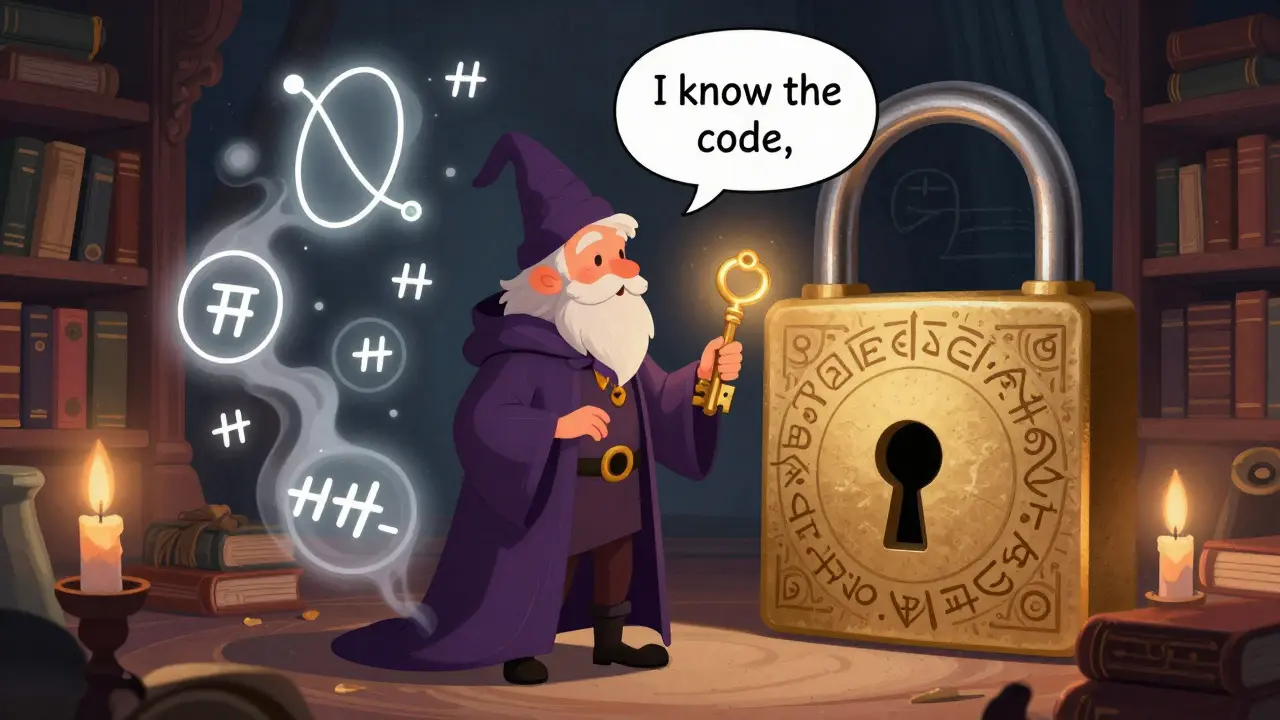
Zero-knowledge proofs (ZKPs) sound like magic: you prove you know something-like a password or a secret transaction-without saying what it is. It’s like proving you have the key to a lock without showing the key. But here’s the catch: this magic isn’t free. Every time you generate or verify a zero-knowledge proof, your computer does serious work. And that work? It costs time, memory, and energy. In blockchain systems where thousands of proofs are verified every minute, that cost adds up fast.
Why Zero-Knowledge Proofs Exist
Zero-knowledge proofs were invented in 1985 by Shafi Goldwasser, Silvio Micali, and Charles Rackoff. Their goal wasn’t to make cryptography flashy-it was to solve a real problem: how do you prove you know something without leaking it? Imagine you’re trying to prove you know the solution to a complex math puzzle. Normally, you’d just show the answer. But what if the answer is your private key, your bank PIN, or the details of a secret transaction? Revealing it defeats the whole point. ZKPs let you prove you know it, without ever showing it.This isn’t just theory. Blockchains like Zcash, Ethereum, and Polygon use ZKPs to verify transactions privately. In Ethereum’s case, ZKPs help scale the network by compressing thousands of transactions into a single proof. But every time that proof is generated or checked, the system pays a price.
How ZKPs Work (Simplified)
At their core, ZKPs turn problems into circuits. Think of a circuit like a factory line: inputs go in, gates process them, and an output comes out. For example, if you want to prove you know the solution to a Sudoku puzzle, you build a circuit that checks whether the numbers follow the rules. The prover runs the circuit with their secret input and generates a proof. The verifier runs a much simpler check on that proof to see if it’s valid.The trick? The verifier doesn’t see the input. They don’t see the Sudoku solution. They only see a mathematical signature that says, “This proof was generated correctly.” The math behind this involves heavy-duty operations: modular arithmetic, elliptic curve pairings, polynomial commitments, and hash functions-all done over huge numbers.
That’s where the cost comes in.
The Three Big Costs: Proving, Verifying, and Generating
There are three main computational costs in ZKPs:- Prover cost: How hard is it for the person creating the proof to generate it?
- Verifier cost: How fast can someone else check that the proof is real?
- Setup cost: How much work is needed before any proof can even be made?
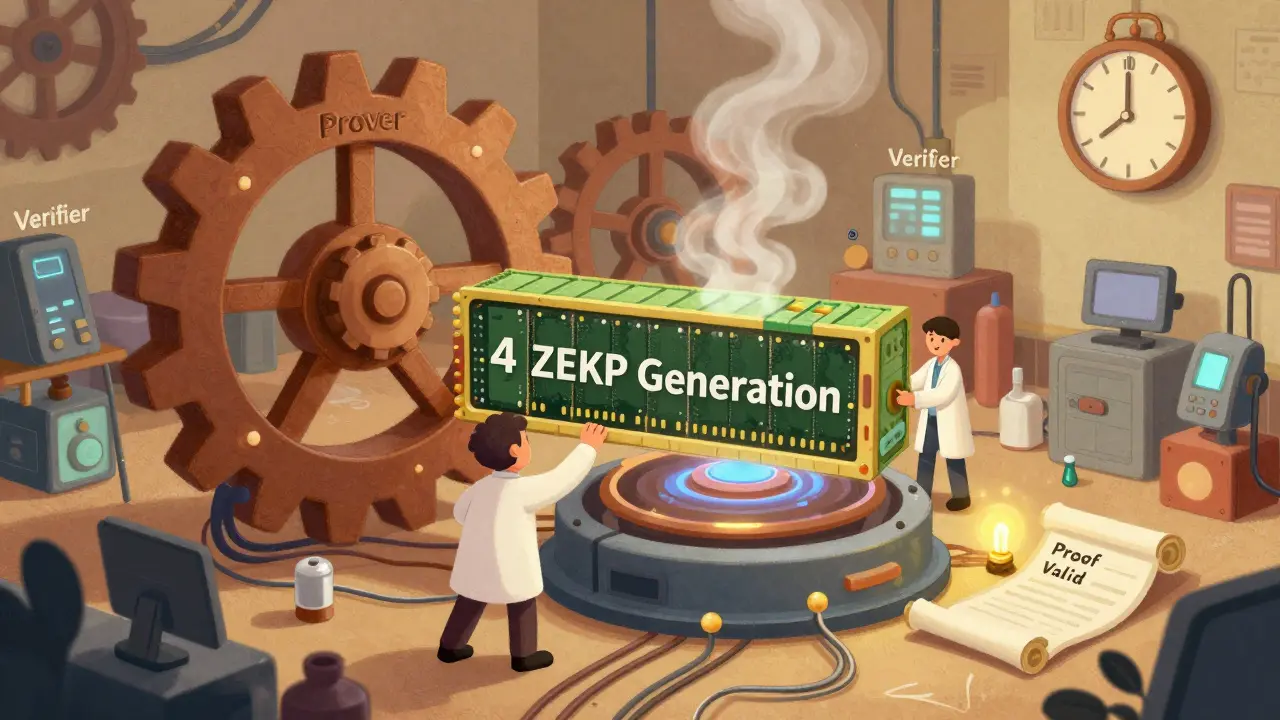
Prover cost is usually the heaviest. Generating a ZKP for a single Ethereum transaction can take 1-5 seconds on a high-end server. For complex smart contracts? It can take minutes. That’s why ZK-rollups don’t generate proofs on phones-they use powerful cloud servers or specialized hardware.
Verifier cost is the opposite: it’s designed to be cheap. A ZKP verifier might only need a few milliseconds to check a proof, even if the original computation took hours. That’s the whole point-make verification fast so blockchains can scale.
Setup cost is often overlooked. Many ZKP systems need a one-time “trusted setup.” Think of it like creating a secret key that everyone uses to generate proofs. If that key is compromised, the whole system breaks. Newer systems like PLONK and Groth16 try to reduce this risk, but they still require heavy computation upfront.
Real Numbers: What Does This Cost in Practice?
You won’t find exact numbers in most academic papers-but real-world deployments tell a clearer story.In 2023, Zcash reported that generating a single shielded transaction proof took about 1.2 seconds on a 16-core AWS instance. By 2025, with improved hardware and optimized circuits, that time dropped to under 0.8 seconds. Still, that’s 800 milliseconds of pure CPU time per transaction. Multiply that by 10,000 transactions per day? That’s over 22 hours of continuous computation just for one ZK-rollup.
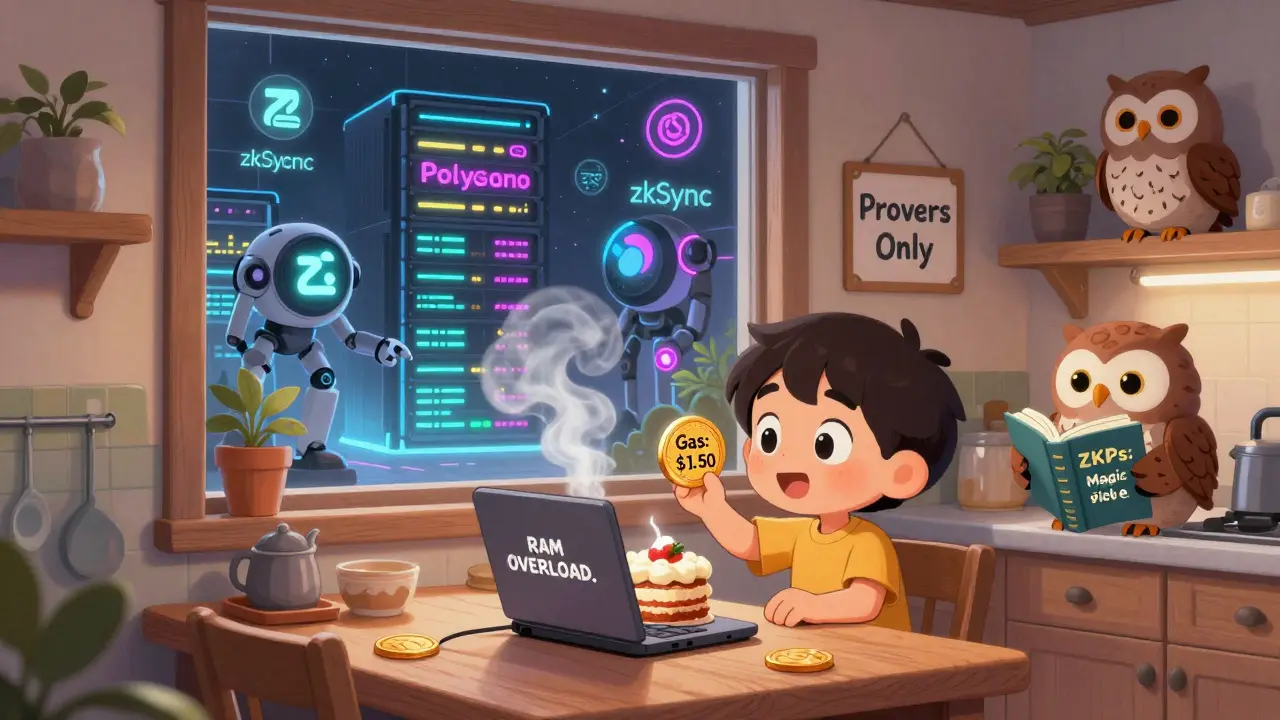
On the verifier side, Ethereum’s zkEVM verifies a ZKP in about 150 milliseconds. That’s fast enough to fit into a block. But each verification still costs around 500,000 gas-roughly $1.50 at current prices. That’s why most ZK-based dApps only use proofs for batched transactions, not every single action.
Memory usage is another hidden cost. Generating a proof for a simple transfer might require 2-4 GB of RAM. For complex DeFi operations? It can hit 16 GB. Most consumer devices can’t handle that. That’s why ZK systems rely on centralized proving services-like Polygon’s Hermez or StarkWare’s StarkNet provers.
Why the Cost Matters for Blockchains
Blockchains aren’t just about decentralization-they’re about scalability. ZKPs were supposed to solve the scaling problem. But if generating proofs is too slow or expensive, you end up centralizing the proving process. That defeats part of the point.Right now, most ZK-rollups use a small group of provers. These are high-end machines, often running in data centers. That’s not decentralized. It’s just outsourcing computation to a few powerful servers. The community calls this the “prover centralization problem.”
There’s a race to fix it. Projects like zkSync, Scroll, and Polygon are investing millions into optimizing circuits, reducing gate counts, and building custom silicon (ASICs) just for ZKP generation. Some are even experimenting with GPU-based proving farms. The goal? Cut proving time in half and make it cheap enough for anyone to run a prover at home.
Trade-Offs: Security vs. Speed
You can’t have it all. Faster proofs often mean weaker security assumptions. For example:- Some ZKPs rely on “trusted setups”-a single secret key that, if leaked, breaks everything.
- Others use weaker cryptographic assumptions to speed things up, making them vulnerable to future quantum attacks.
- Some systems sacrifice proof size for speed: smaller proofs are faster to verify but harder to generate.
There’s no universal “best” ZKP. Groth16 is fast to verify but needs a trusted setup. PLONK is more flexible and doesn’t need a new setup for every app-but it’s slower to generate. StarkWare’s STARKs don’t need trusted setups and are quantum-resistant, but their proofs are bigger and take longer to verify.
Choosing a ZKP system isn’t just about tech-it’s about your threat model. Are you protecting user privacy? Then you might accept slower proving. Are you scaling a global payment network? Then you need speed, even if it means trusting a few provers.
What’s Changing in 2025?
The last two years have seen massive progress:- Hardware acceleration: Companies like NVIDIA and Intel are releasing GPU and FPGA libraries optimized for elliptic curve math.
- Circuit optimization: Tools like Circom and Leo now auto-optimize circuits, cutting gate counts by 30-50%.
- Recursive proofs: You can now prove a proof. That means one ZKP can verify dozens of others, reducing overall load.
- Open-source provers: Projects like zkEVM-Community are releasing free, open-source proving software so anyone can contribute.
By 2025, the average ZKP generation time for a simple transaction is down to 0.6 seconds. That’s 40% faster than in 2023. But it’s still not fast enough for real-time apps like gaming or micropayments. The next frontier is sub-100-millisecond proving on consumer hardware.
What You Can Do Today
If you’re building on a ZK blockchain:- Use batched proofs. Don’t generate one per transaction-group 100+ into one proof.
- Keep your circuits small. Every extra logic gate increases proving time exponentially.
- Test on real hardware. Don’t assume your laptop can handle it. Use cloud instances with 32GB+ RAM.
- Don’t ignore the setup. If your system needs a trusted setup, make sure it’s been audited and uses multi-party computation (MPC).
If you’re just using a ZK app, you don’t need to worry-most of the cost is handled behind the scenes. But understand this: every time you interact with a ZK-powered wallet or exchange, someone else is doing heavy lifting so you don’t have to.
The Bottom Line
Zero-knowledge proofs are revolutionary. They let us verify truth without revealing secrets. But they’re not magic. They’re math. And math has a price.The computational cost is still high. But it’s falling fast. In five years, ZKPs might be as common as HTTPS. Right now, they’re like early internet: powerful, but only usable by those with the right tools.
What matters isn’t whether ZKPs are expensive-it’s whether we’re willing to pay that cost to get true privacy on open networks. And so far, the answer is yes. Because the alternative-exposing every transaction-is worse.

Rebecca Andrews
I'm a blockchain analyst and cryptocurrency content strategist. I publish practical guides on coin fundamentals, exchange mechanics, and curated airdrop opportunities. I also advise startups on tokenomics and risk controls. My goal is to translate complex protocols into clear, actionable insights.
26 Comments
-
Sally Valdez
December 18, 2025 AT 14:32So we’re spending billions to prove we know a password without saying it? Meanwhile, China’s building quantum supercomputers and we’re optimizing elliptic curves like it’s 2012. This isn’t innovation - it’s digital yoga for rich guys who don’t want their crypto habits tracked. Wake up.
-
Elvis Lam
December 20, 2025 AT 08:20Prover cost is the real bottleneck. You’re right about the 2-4GB RAM for simple transfers - I’ve seen devs blow through $200/hr AWS instances just testing circuits. The fix? Circuit minimization. Use Circom’s built-in optimizations, avoid nested loops, and precompute constants. And stop using Groth16 unless you’re doing one-off proofs. PLONK’s setup overhead is worth it for reusability.
-
Florence Maail
December 20, 2025 AT 19:10They say ZKPs are about privacy… but who’s really running the provers? Big tech. AWS. Google Cloud. They’re the ones holding the keys. You think this is decentralized? Nah. It’s just a fancy way to outsource surveillance to Silicon Valley. 😏
-
Jonny Cena
December 22, 2025 AT 16:02For anyone building on ZK right now - don’t panic. The cost is high, but it’s dropping fast. Use batched proofs. Test on cloud instances. And if you’re worried about trusted setups, look into MPC ceremonies - they’re messy but way safer. You’re not alone in this. The community’s got your back.
-
George Cheetham
December 22, 2025 AT 19:58There’s something almost spiritual about ZKPs - proving truth without revealing essence. It mirrors ancient philosophical ideas of inner knowledge, of wisdom that cannot be stolen or copied. But the machine demands sacrifice: time, power, memory. We are offering our digital flesh to the gods of computation. Is that the price of freedom? Or just the new form of digital penance?
-
Sue Bumgarner
December 24, 2025 AT 05:56Oh so now we’re supposed to believe that ZKPs are the future? Tell me again why we’re not just using homomorphic encryption? Or even good ol’ AES with key rotation? This whole thing feels like a VC-funded magic trick to sell more blockchain tokens. You’re all just chasing hype.
-
Kayla Murphy
December 24, 2025 AT 22:36I know it sounds like a lot, but think of it this way - every time you use a ZK wallet, you’re helping build a world where no one can track your purchases, your donations, your private conversations. That’s worth a few extra milliseconds. We’re not just coding - we’re protecting.
-
Tom Joyner
December 25, 2025 AT 02:53It’s amusing how the ‘decentralized’ ZK ecosystem relies entirely on AWS t3.xlarge instances and proprietary FPGA firmware. The irony is not lost on those who understand the difference between decentralization and distributed centralization.
-
Amy Copeland
December 26, 2025 AT 19:43Wow. So you wrote a 2000-word essay on how expensive math is? Congrats. You just proved you can use a thesaurus. Meanwhile, real people just want to send $5 without paying $1.50 in gas. Maybe stop glorifying complexity and start solving for humans?
-
Chevy Guy
December 27, 2025 AT 05:32They say the trusted setup is safe… but what if the key was planted by the NSA? What if the ‘open-source prover’ is just a backdoor wrapped in a GitHub README? You think they’d let us run ZK on our own machines if they couldn’t watch it? Think deeper.
-
Samantha West
December 28, 2025 AT 18:04One must consider the epistemological implications of zero-knowledge verification: the assertion of knowledge without ontological disclosure constitutes a radical reconfiguration of the epistemic contract between agent and system. The computational burden, while significant, is merely the phenomenological surface of a deeper epistemic rupture - one wherein verifiability is divorced from visibility, and truth becomes a cryptographic signature rather than an experiential fact.
-
Rebecca Kotnik
December 30, 2025 AT 14:02I’ve been working with zkEVM for over a year now, and I can tell you - the progress is real. The shift from Groth16 to PLONK wasn’t just technical, it was philosophical. We moved from brittle, single-use setups to reusable, auditable ones. The memory usage is still brutal, but recursive proofs? That’s the real game-changer. One proof verifying ten others? That’s not optimization - that’s evolution.
-
Dionne Wilkinson
December 31, 2025 AT 11:51I just want to send crypto to my grandma without her needing a PhD in computer science. If ZKPs make that possible, even if it’s slow, I’m all for it. It’s not about the tech - it’s about giving people back control. Slow is better than exposed.
-
Emma Sherwood
January 1, 2026 AT 12:04Back in Mumbai, we use ZK for microloans - proving someone’s creditworthiness without exposing their income or bank history. It’s not just tech - it’s dignity. People who’ve been locked out of finance for generations now have a way to prove trust without begging for permission. That’s why this matters.
-
Kelsey Stephens
January 2, 2026 AT 22:59For everyone freaking out about the cost - remember, we’re early. Look at how long it took for SSL to become fast enough for every website. ZKPs are where HTTPS was in 1998. We’ll get there. Keep building. Keep testing. The community’s growing.
-
Abby Daguindal
January 3, 2026 AT 10:03Everyone’s so excited about ZKPs… but nobody talks about how they’re making privacy a luxury. Only the rich can afford to run provers. The rest of us? We just get to hope someone else did the math for us. Great. Another elite club.
-
SeTSUnA Kevin
January 3, 2026 AT 18:00Prover cost dominates. Circuit optimization reduces gate count. Recursive proofs compress verification. Hardware acceleration cuts latency. These are not optional - they are necessary. The rest is noise.
-
Timothy Slazyk
January 5, 2026 AT 01:20Let’s be honest - the real innovation isn’t the math. It’s the cultural shift. We’re moving from ‘show me’ to ‘prove it to me.’ That’s a revolution in trust architecture. The cost? A temporary tax on progress. The reward? A world where identity, ownership, and truth are no longer commodities to be sold.
-
Madhavi Shyam
January 5, 2026 AT 12:22PLONK’s universal SRS is O(n log n) complexity - Groth16 is O(n). STARKs have O(n) verification but O(n log n) proving. Circuit size matters more than algorithm choice. Use Leo for declarative circuit design. Avoid recursion unless you need it. And never use SNARKs for on-chain verification without gas budgeting.
-
Mark Cook
January 7, 2026 AT 10:29Zero-knowledge? More like zero-common-sense. Why not just encrypt the transaction and let the chain decrypt it? This is like using a rocket launcher to open a jar. 🤦♂️
-
Jack Daniels
January 7, 2026 AT 18:01They’re watching. Always watching. Even when you don’t show the key, the proof leaves a fingerprint. You think they don’t track proving times? They know who’s hiding what. I’m not using it.
-
Bradley Cassidy
January 8, 2026 AT 06:19so like… zkp is cool but the ram usage?? bro my 16gb laptop just died trying to run a simple circuit 😭 i think we need like… zkp for dummies or something? maybe a zkp plugin for chrome??
-
Craig Nikonov
January 9, 2026 AT 12:30They say ZKPs are quantum-resistant? Lol. STARKs might hold for now, but the moment Shor’s algorithm hits 1000 qubits, every single ZK proof ever generated becomes a public ledger of secrets. And who’s gonna audit the auditors? The same people who built the system? Yeah right.
-
Terrance Alan
January 10, 2026 AT 04:17Let me tell you something about zero-knowledge proofs - they’re not magic. They’re math. And math doesn’t care if you’re poor or rich or woke or conservative. It just runs. And when it runs, it burns electricity. It burns time. It burns human effort. And for what? So you can send crypto without someone knowing how much? Fine. But don’t pretend this is liberation. It’s just a more expensive lock on the same cage.
You want privacy? Stop using centralized exchanges. Stop using wallets that require phone verification. Stop trusting anyone who says ‘it’s handled behind the scenes.’ That’s not privacy. That’s delusion wrapped in a whitepaper.
And while we’re at it - why are we all so obsessed with proving we know things without revealing them? What happened to just being honest? Maybe the real problem isn’t the cost of ZKPs. Maybe it’s that we’ve forgotten how to trust each other without a cryptographic signature.
I’ve watched this whole thing unfold. From the early days of Zcash to today’s billion-dollar rollups. And the truth? We’re not building a new internet. We’re building a new religion. And like all religions, it demands sacrifice. We’re just the ones holding the torch.
So go ahead. Optimize your circuits. Run your provers on AWS. Shout about recursive proofs. But don’t fool yourself. The cost isn’t just computational. It’s spiritual.
-
Elvis Lam
January 10, 2026 AT 14:39For those asking about GPU provers - NVIDIA’s cuZK library is actually usable now. Drop your Circom circuits into their pipeline, and you can get 3x speedup on A100s. Also, StarkWare’s Cairo compiler now auto-parallelizes arithmetic gates. Stop using manual optimizations unless you’re doing something exotic.


Write a comment
More Articles

Crypto Restrictions for Qatar Residents: What's Banned and What's Allowed in 2025
Qatar bans Bitcoin and all cryptocurrencies but allows tokenized real estate, bonds, and commodities under strict regulations. Learn what's legal, what's not, and how to invest safely in 2025.

Sammy Tam
December 17, 2025 AT 01:05Man, I remember when ZKPs were just a nerdy dream. Now they’re powering entire blockchains and I still can’t get my laptop to generate one without screaming into the void. The fact that we’re down to 0.6 seconds per proof is wild - but also, why does my phone still crash trying to open a ZK wallet? Someone’s gotta make this stuff run on toaster-level hardware.